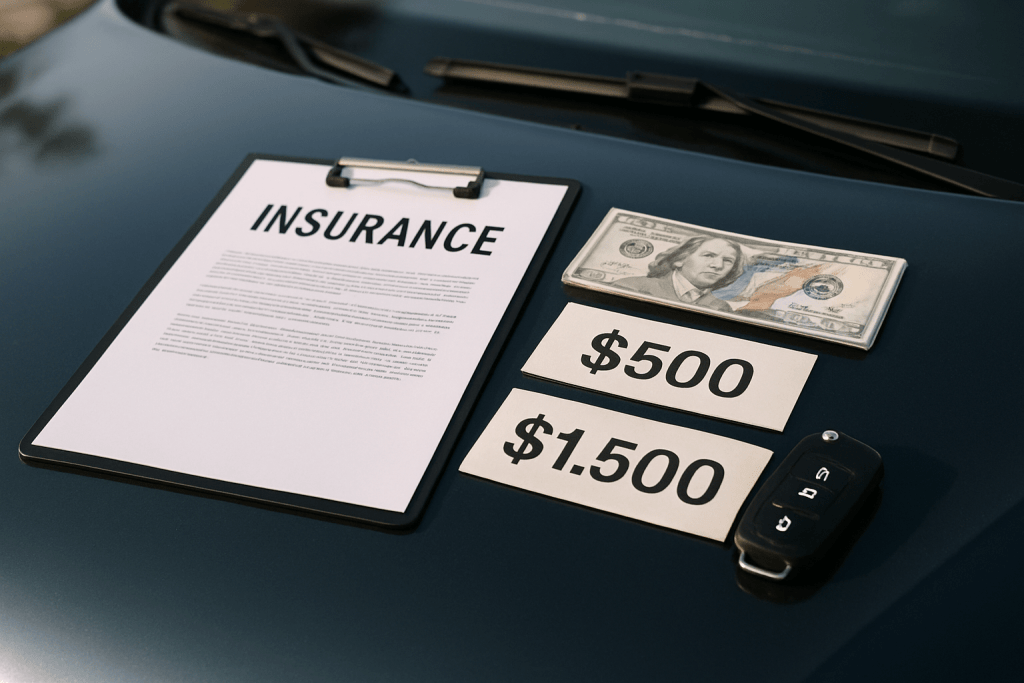
When choosing between a $500 and a $1,500 car insurance deductible, it’s easy to treat it as a pricing question. But it’s really a cash-flow decision: pay more every month to reduce risk, or save on premiums and absorb a larger bill if something goes wrong. The right deductible balances your monthly payment, your emergency savings, and how likely you are to file a claim.
The Key Points: TL;DR
- A lower $500 deductible means higher premiums but less cash needed after an accident or theft claim.
- A higher $1,500 deductible usually cuts premiums; the key question is whether you can comfortably cover that $1,500.
- Find your break-even: extra $1,000 deductible divided by yearly premium savings tells you how many years you must go claim‑free.
- If you share cars or have a tight budget, keeping at least one vehicle with a lower deductible can help avoid a double financial hit.
- Pair your deductible choice with a growing emergency fund so one accident doesn’t wipe out your savings or budget.
The difference between a $500 and $1,500 deductible is $1,000 (a month’s rent, two car payments, or the entire emergency fund for millions of Americans). Choose wrong, and you’re either bleeding money through premiums you can’t afford or stuck with a repair bill that sends you straight to credit cards.
Car insurance deductible explained in simple terms
Your deductible is what you pay before insurance kicks in. Damage costs $3,000 with a $500 deductible? You pay $500, they pay $2,500. Same damage with a $1,500 deductible? You’re on the hook for $1,500 while they cover $1,500.
Each coverage type has its own deductible. Collision covers crashes. Comprehensive handles everything else: theft, vandalism, that deer you hit at dawn. According to the Insurance Information Institute, adjusting deductibles remains the fastest way most drivers can change their premiums.
If the terminology feels confusing, Finhabits’ car insurance basics guide breaks down exactly what each coverage type actually protects.
What happened: premiums when you raise your deductible
The promise sounds simple: higher deductible equals lower premium. But how much lower? Real quotes for identical coverage on the same vehicle:
- $500 collision and comprehensive deductible: $180 per month
- $1,500 collision and comprehensive deductible: $145 per month
That $35 monthly difference adds up to $420 yearly, $840 over two years. The question isn’t whether you save; it’s whether those savings outweigh the risk of needing that extra $1,000 when metal meets metal. For context on typical costs in your situation, check Finhabits’ car insurance cost breakdown.
Why it matters: your break-even point
The math that actually matters:
| Deductible option | Monthly premium | Yearly premium | Extra deductible | Yearly savings | Years to break even |
|---|---|---|---|---|---|
| $500 deductible | $180 | $2,160 | – | – | – |
| $1,500 deductible | $145 | $1,740 | $1,000 more than $500 | $420 annual savings | About 2.4 years ($1,000 ÷ $420) |
Extra deductible ÷ yearly premium savings = years to break even.
In this scenario: $1,000 ÷ $420 ≈ 2.4 years. Go longer than 2.4 years without filing a claim, and the higher deductible saves money. File sooner, and you would have been better off with the lower deductible. This calculation becomes your decision’s foundation, not the salesperson’s recommendation, not what your neighbor chose.
What to do: test your own numbers
Generic advice fails because your driving pattern, financial cushion, and risk tolerance are unique. Pull your actual quotes and run the math yourself using guidance from the Finhabits deductible 101 guide. Calculate:
- Annual cost for each deductible option (monthly premium × 12).
- Annual savings from choosing the higher deductible.
- Your personal break-even timeline using the formula above.
Now the crucial reality check: Can you actually go that long without a claim? Consider your daily commute distance, whether you park on streets or in garages, your city’s accident rates, and your own driving history. A three-year break-even means nothing if you’ve filed two claims in the past four years.
Real claim sizes: $800, $2,500, $6,000
Theory meets reality when damage happens. Using those same premiums ($180/month at $500 deductible, $145/month at $1,500), watch how different claim amounts play out.
$800 claim (minor scrape in a parking lot)
- With $500 deductible: you pay $500; insurer pays $300.
- With $1,500 deductible: you pay all $800; insurer pays nothing.
$2,500 claim (typical intersection collision)
- $500 deductible: you pay $500; insurer pays $2,000.
- $1,500 deductible: you pay $1,500; insurer pays $1,000.
$6,000 claim (T-boned at a red light)
- $500 deductible: you pay $500; insurer pays $5,500.
- $1,500 deductible: you pay $1,500; insurer pays $4,500.
Notice the pattern: that extra $1,000 hits regardless of claim size. For small claims under $1,500, the higher deductible effectively means no insurance at all. The trade-off becomes stark: Is saving $35 monthly worth potentially eating the entire cost of minor accidents?
Collision vs comprehensive: when a higher deductible backfires
Most drivers pick one deductible for everything, but insurers let you split them. This flexibility matters more than you might expect.
A cracked windshield might cost $600 to replace. With a $1,500 comprehensive deductible, you’re paying every penny. But comprehensive claims (glass, theft, weather damage) often cost less than major collisions. Some drivers keep comprehensive at $500 while raising collision to $1,500, protecting against common smaller losses while accepting bigger risk on major accidents.
Understanding exactly which damage falls under which coverage type can save hundreds. Finhabits’ guide on how car insurance works clarifies these distinctions so you make informed choices.
Emergency fund vs high deductible: who pays first?
A $1,500 deductible without $1,500 in accessible savings is a financial time bomb. The math only works when you can actually cover that deductible without destroying your budget or reaching for credit cards.
Think about it: you chose the higher deductible to save $420 yearly. But if an accident forces you to put $1,500 on a credit card at 22% APR, you’ll pay $330 in interest the first year alone, nearly wiping out your premium savings. The supposed bargain becomes more expensive than the original option.
Building that cushion takes planning. Finhabits shows how systematic saving creates this buffer; you can open an investment account as an emergency fund so the money is both accessible and working for you* while it waits.
What to ask your insurer before changing your deductible
Generic online calculators won’t give you real numbers. Call your insurer directly and ask:
- “What exactly will my premium be if I change from $500 to $1,500 on this specific vehicle (not an estimate, the actual number)?”
- “Can I set different deductibles for collision versus comprehensive? What would each combination cost?”
- “Are glass claims handled differently? Is there separate glass coverage with a lower deductible?”
Take those real numbers and run them through the break-even formula. Then align the results with your savings plan. Even modest automatic contributions can build the cushion you need.
FAQ: car insurance deductible questions
How does a car insurance deductible work?
Your car insurance deductible is the amount you pay on a covered claim before the insurer pays. If repairs cost $4,000 and your deductible is $500, you pay $500 and the insurer pays up to $3,500, subject to limits and exclusions in your policy.
Is a $500 or $1,500 car insurance deductible better?
Neither is always better. A $500 deductible is safer if your savings are low or you drive a lot. A $1,500 deductible can make sense when you have a solid emergency fund and you are comfortable taking more short‑term risk to lower long‑term premiums.
What is the break-even point for a higher deductible?
The break‑even point is when premium savings equal the extra deductible you would owe in a claim. Divide the extra deductible ($1,000 in this example) by your yearly premium savings. If you expect to go longer than that many years without a claim, the higher deductible usually wins.
How can Finhabits help me align my deductible with my savings?
Finhabits offers educational guides that connect insurance decisions with habits like building an emergency fund and automating contributions in an investment account. Exploring resources such as our comparison tool and the car insurance cost overview can help you choose a deductible that fits your overall money plan.
Connect your deductible to your bigger money picture
The deductible decision becomes clearer when you know exactly how much emergency cash you have and how fast it can grow*. Finhabits’ educational resources tie insurance choices directly to building financial stability.
Next step: Explore guides like car insurance basics before year‑end and compare quotes with our comparison tool.
Conclusion
The $500 versus $1,500 deductible decision boils down to one question: Can you handle that extra $1,000 hit without derailing your finances? The break-even math shows when higher deductibles save money. Your emergency fund determines whether you can afford to find out.
Run your actual numbers. Check your real savings. Then choose the deductible that lets you sleep at night knowing one bad driver won’t trigger a financial emergency on top of the actual emergency.
Sources
- Insurance Information Institute (III) – Understanding Your Insurance Deductibles
- National Association of Insurance Commissioners (NAIC) – Auto Insurance Consumer Information