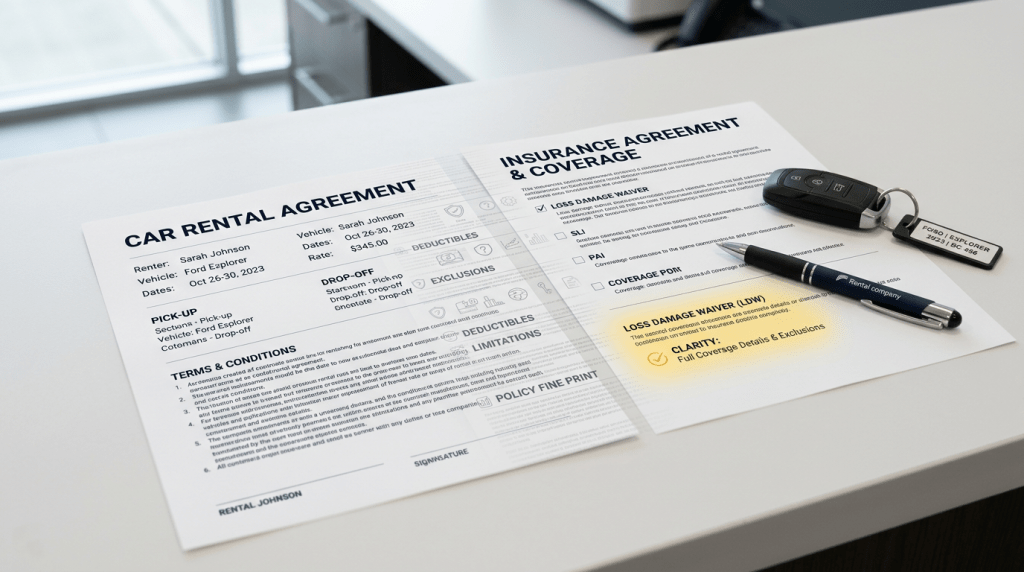
Does car insurance cover rental cars? Usually yes, but that is only part of the story. The coverage that may extend to a rental follows the same limits and deductible you already have. If those limits fall short, your policy will only pay up to the limit, leaving you responsible for the rest. And if the deductible is high, you as the driver can still end up paying real money out of pocket. That is the part most people miss.
Most people walk up to the rental counter thinking the only question is whether the car itself is covered. It’s not that simple. The more important question is what happens if the damage exceeds your policy limits, if the rental car itself is not covered, or if the claim is denied or only partially covered. That is exactly why comparing coverage matters: not because the rental company says so, but because the financial risk can land on the person behind the wheel.
That is exactly why comparing coverage matters: not because the rental company says so, but because the financial risk can land on the person behind the wheel. The key is to compare your coverage before you need it—not at the counter.
TL;DR
- Your personal auto policy may extend to rental cars, but only with the same coverage types, limits, and deductible you already carry.
- If you have only liability coverage, damage to the rental vehicle itself typically is not covered, which means you could be left paying for that loss yourself.
- The rental company’s loss damage waiver (LDW) is a contract waiver, not an insurance policy.
- Credit card rental benefits vary widely and often carry significant exclusions worth checking in advance.
- Knowing your deductible and coverage types before you rent is the single most effective move you can make.
There’s a reason rental counter agents move fast through their add-on pitch. Collision damage waiver. Supplemental liability. Personal effects protection. Each one stacks $15 to $30 per day onto your bill, and you’re given roughly 90 seconds to decide while a line of impatient travelers builds behind you. That environment is fast-paced and often leaves little time to fully understand your coverage, and it works because most people genuinely do not know where the real risk lands. If your coverage is thin, the bill does not just hit the car owner or the rental company. It can hit you.
Does car insurance cover rental cars? The answer hinges entirely on what you carry. And distinguishing between what follows you as a driver, what the rental company sells you, and what your credit card might quietly provide is the difference between a confident decision and an expensive one. The whole point is not simply to know whether some coverage exists, but to know whether you could still be stuck with a deductible, uncovered damage, or excess liability after the fact.
What “Your Policy Follows You” Really Means
This phrase gets repeated so often it’s practically a mantra, yet almost nobody stops to ask what it actually means in practice. In many cases, your personal auto policy extends to rental cars you drive—but the details depend on your coverage.
What happens in reality is that the coverages on your personal auto policy may extend to a rental car you’re driving for personal travel. The specifics depend on your insurer and your state. If you carry full coverage (meaning liability plus comprehensive and collision), those protections typically transfer to a standard rental. Comprehensive coverage handles non-collision events like theft, vandalism, and weather damage. Collision coverage pays for damage from an accident with another vehicle or object. They transfer, however, with identical limits and the same deductible — the out-of-pocket amount you pay before your insurer covers the rest. A $1,000 collision deductible on your own car means a $1,000 deductible on a rental claim. According to the National Association of Insurance Commissioners (NAIC), reviewing your declarations page before renting is the clearest way to understand which coverages actually apply.
Carry only liability? Liability insurance covers injuries and property damage you cause to others, but damage to the rental vehicle itself typically falls outside your coverage. Your liability protection may still respond if you cause damage to another person or their property, but repairing or replacing the rental car you’re driving is a separate problem — and one you’d be shouldering alone.
What Are the Three Coverage Layers People Mix Up?
Rental counter confusion almost always traces back to the same root cause: people conflate three separate sources of protection that overlap in some areas and leave blind spots in others. None of them covers everything on its own.
Your personal auto policy is the foundation. Whatever coverages you carry may extend to a rental, up to the same limits. The coverage you selected (and pay for) determines which protections you have. If your liability limit is $50,000 per accident and a crash you caused totals the rental, your policy covers up to that number. Not a dollar beyond it. Most personal auto policies with comprehensive and collision extend that coverage to rental vehicles for personal use.
The rental company’s loss damage waiver (LDW or CDW) is, despite what the name implies, not insurance. It’s a contractual agreement where the rental company waives its right to charge you for damage to their vehicle. A collision damage waiver (CDW) typically covers collision-related damage, while an LDW may also include theft protection. It often ranges roughly from $10 to $40+ per day depending on vehicle type and location, and covers the rental car only — not your liability to others, not medical expenses, not personal belongings. That distinction matters more than most renters realize.
Credit card benefits are the wildcard that people overestimate most often. Most credit cards offer secondary coverage, though some premium cards provide primary coverage, meaning they pay after your auto policy has been exhausted. Many renters rely on their credit card’s rental coverage without fully understanding whether it’s primary or secondary. Many cards exclude larger vehicles, certain countries (Ireland, Italy, Israel, Australia, and New Zealand are common exclusions), or rental periods exceeding 15 to 31 days depending on the card network. The specifics live in your card’s benefit guide, and the differences between cards from the same issuer can be dramatic.
The Situations That Create the Most Confusion
Coverage is stubbornly context-dependent. These are the scenarios where even careful, well-prepared renters get caught off guard.
Renting for vacation. If you carry full coverage and you’re renting a standard domestic vehicle, your policy typically extends. Your deductible still applies, but you’re generally covered for collision and comprehensive claims. This is the straightforward case, and the one that makes people mistakenly assume every rental situation works the same way.
Renting while your car is in the shop. This involves a completely different part of your policy: rental reimbursement coverage, a separate add-on that helps pay for a rental while your car is being repaired after a covered loss. According to the Insurance Information Institute (III), on average a car is in the repair shop for two weeks after an accident, making this coverage a genuine bargain at just a few dollars per month, though it carries a daily and per-incident cap. Without it, you pay out of pocket, even when the accident wasn’t your fault.
Renting internationally. Most U.S. auto policies cover rentals within the U.S. and often Canada, but typically not Mexico or other countries. Mexico is the most common scenario; if you’re crossing, separate local insurance is typically required. The U.S. State Department advises that your domestic auto insurance may not cover you when driving in other countries and recommends purchasing local coverage for any international rental.
Renting specialty vehicles. Cargo vans, large trucks, and luxury or exotic cars frequently fall outside a standard personal policy’s scope. If you’re renting anything beyond a typical sedan, SUV, or minivan, confirm with your insurer before you sign anything.
When Should You Accept Rental Car Coverage?
The contrarian move isn’t always declining everything at the counter. Sometimes the smartest financial decision is saying yes — and knowing exactly why.
You carry liability only. Without collision or comprehensive, damage to the rental car comes straight out of your pocket. The LDW closes that gap directly. If you rent occasionally, buying the waiver each time may cost less than upgrading your policy year-round. If you rent frequently, it’s worth understanding what full coverage car insurance includes to determine whether upgrading your base policy makes more long-term sense.
You have a high deductible. A $1,500 deductible might be a smart premium strategy on your own car, but that same amount from a fender-bender on a rental you’re returning in four days stings in a way you didn’t budget for. If absorbing that cost would strain your finances, the waiver delivers genuine value for a few days of peace of mind.
You’re renting internationally. As covered above, U.S. policies generally don’t apply outside the country. In most cases, buying the rental company’s local coverage is the only realistic protection available.
What Should You Check Before You Rent?
The ability to confidently decline or accept coverage at the counter comes from doing one thing nobody wants to do: reading your own policy before you need it.
Start with your declarations page, the summary your insurer sends at each renewal. It lists your coverage types, limits, and deductible. If collision and comprehensive appear, your policy likely extends to a standard domestic rental. If you see only liability, it probably doesn’t cover damage to the rental vehicle itself. Also check whether you carry uninsured motorist coverage — protection that pays your expenses if you’re hit by a driver without insurance. According to the Insurance Research Council, 15.4% of U.S. drivers were uninsured in 2023, and one in three (33.4%) were either uninsured or underinsured.
Then look at your deductible. Whatever you’d owe on your own car is likely what you’d owe on a rental claim. If that number would create genuine financial strain, accepting coverage at the counter isn’t wasteful spending — it’s risk management.
If comparing coverage configurations feels overwhelming, you can simplify the process by comparing auto insurance options on Finhabits, where different coverage levels and deductibles are easy to evaluate side by side, well before you’re standing in a rental line under pressure.
Frequently Asked Questions
Does car insurance cover rental cars if I only have liability?
Your liability coverage may extend to claims others make against you while driving a rental, covering injuries or property damage you cause. But it typically won’t cover damage to the rental vehicle itself. Liability insurance pays for bodily injury and property damage you cause to others, not damage to the car you’re driving. For that, you’d need to buy the rental company’s loss damage waiver or add collision coverage to your own policy. Most full-coverage personal auto policies extend to rental vehicles for personal use.
Is a loss damage waiver the same as rental car insurance?
Not quite. An LDW or CDW is a contractual agreement where the rental company waives its right to charge you for damage to their vehicle — not an insurance policy. CDW waivers typically cost $10 to $42 per day depending on the vehicle type and location. They don’t cover your liability to others, medical expenses, or personal belongings. Actual insurance would address each of those separately. The Collision Damage Waiver segment accounts for roughly 45% of the global rental car insurance market, underscoring how common this purchase is.
Do I need rental coverage if my credit card already covers it?
Credit card rental benefits vary significantly by card and issuer. Most credit cards offer secondary coverage, though some premium cards provide primary coverage, meaning your auto policy pays first, and the card covers what’s left — often just your deductible. Some cards exclude specific vehicle types, countries like Ireland, Italy, Israel, and Australia, or rentals over 15 to 31 days depending on the network. Many renters rely on credit card rental coverage without fully understanding whether it’s primary or secondary. Read your card’s benefit guide before renting, not after you’ve already declined the desk’s options.
Does my car insurance cover a rental car in another state?
In most cases, yes — your personal auto policy generally extends to rental cars driven anywhere in the U.S. Coverage limits and state minimum requirements can vary, but domestic rentals are typically covered. Renting internationally is a different situation: most U.S. policies don’t apply outside the country, and separate local insurance is usually required. According to the Insurance Research Council’s 2025 study, 15.4% of U.S. drivers — about one in seven — were uninsured in 2023, and one in three (33.4%) were either uninsured or underinsured. That’s why uninsured motorist coverage on your own policy also protects you on the road, whether in a rental or your own car.
When you’re ready to look at your own coverage with clearer eyes, choosing the right car insurance deductible is a practical starting point — because the deductible you carry on your personal policy directly shapes what you’d owe on any rental claim, and whether the counter’s add-ons make financial sense for your situation.
The Bottom Line
Does car insurance cover rental cars? Often yes, but only with the coverage you already carry, at the limits and deductible you’ve already chosen. The question that actually matters isn’t whether you have some protection. It’s whether what you have is sufficient for the specific rental you’re about to drive off the lot.
That clarity never materializes in a rental line. It comes from reviewing your policy while you still have time to adjust it. Know your deductible, know your coverage types, know your limits — and the 90-second sales pitch at the counter becomes a conversation you can navigate on your own terms.
Sources
- National Association of Insurance Commissioners (NAIC) – Auto Insurance Consumer Guide
- Insurance Information Institute (III) – Does Auto Insurance Cover a Rental Replacement Car After an Accident?
All sources accessed and verified on March 19, 2026. External links open in new window.
Disclaimer:
Insurance services are offered by Finhabits Insurance Services LLC, an agency licensed in certain states. California License 6001946. See licenses at www.finhabits.com/insurance-licenses for more details. In all other states, Finhabits Inc. provides information for educational purposes only. All information in this document, as well as any communications on social media, is not an offer of insurance in any state except those where licensed. Finhabits Advisors LLC is not a fiduciary with respect to the products or services of Finhabits Insurance Services LLC.
Investment advisory services are offered through Finhabits Advisors LLC, a registered investment advisor with the SEC. Registration does not imply a certain level of competency or training. Past performance does not guarantee future results or returns. All investments involve risk and may result in losses. Securities offered through Apex Clearing Corporation, Member FINRA, SIPC. Your assets held with Apex are protected by SIPC up to $500,000, which includes a $250,000 cash limit.
© Finhabits Insurance Services. 310 N Mesa Suite 211 El Paso, TX 79901. All rights reserved.