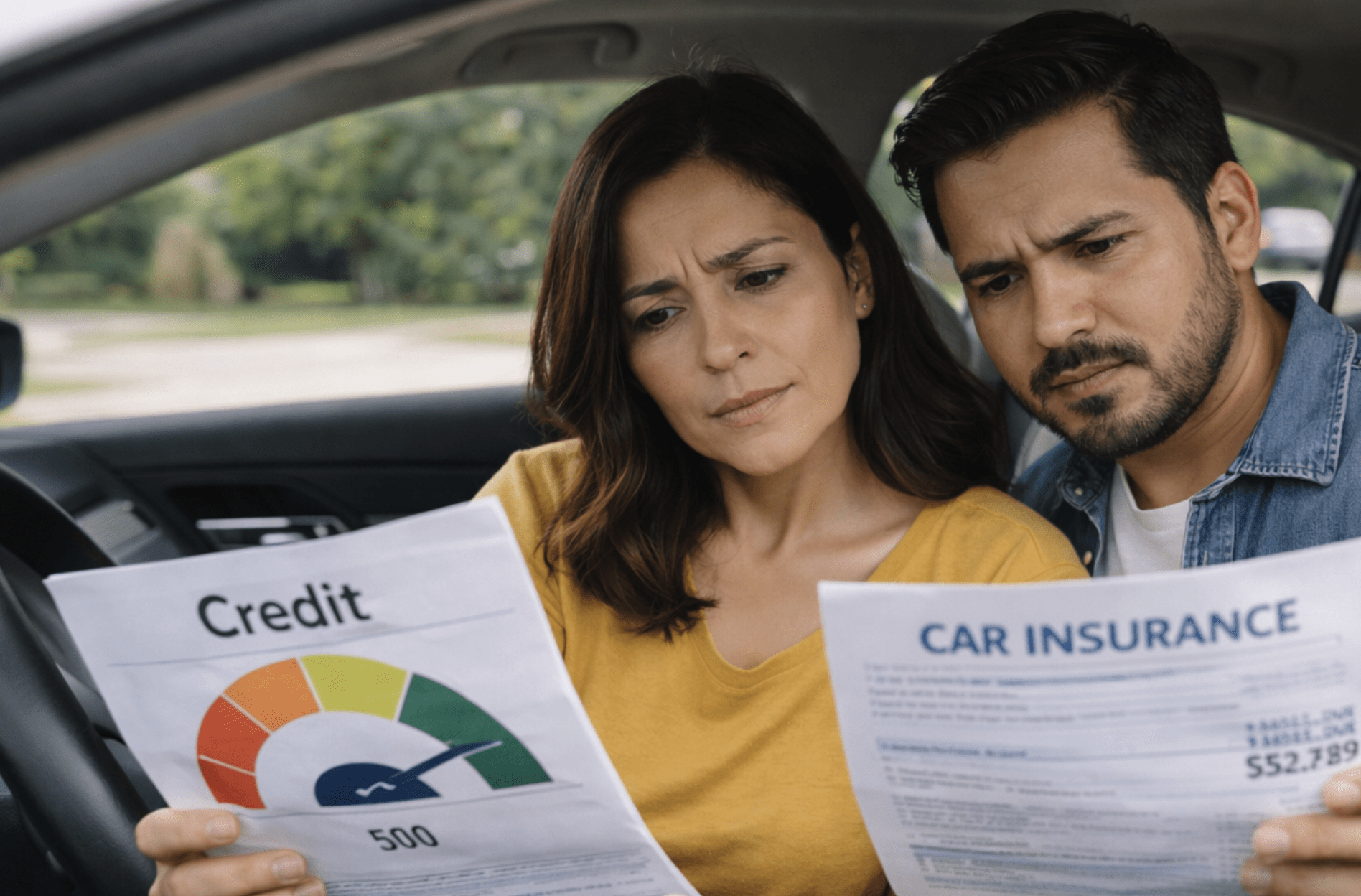
Your credit score and car insurance rates are closely connected, and the financial impact can be significant. In many U.S. states, drivers with lower credit scores may pay substantially more for similar coverage compared to those with higher credit scores, based on industry analyses. This can translate into hundreds of additional dollars per year, even for drivers with clean driving records.
TL;DR
- Most insurers use a credit-based insurance score, not your FICO score, to help set your premium.
- Poor credit can nearly double your car insurance cost compared to excellent credit for the same coverage.
- California, Hawaii, Massachusetts, and Michigan ban credit-based insurance pricing entirely.
- Payment history is the single heaviest factor in both your credit and insurance scores.
- Comparing quotes from multiple carriers matters because each one weighs credit very differently.
One critical detail most people miss: insurers aren’t pulling your exact FICO number. They use something called a credit-based insurance score, built from the same credit report data but weighted with a completely different formula. And because every insurer runs its own model, the same credit profile can generate quotes that vary by hundreds of dollars from one company to the next.
What this means for you: If your credit isn’t strong, or you haven’t compared rates in a while, you may be paying more than necessary for your coverage. What you can do today: compare car insurance rates from multiple carriers to see how different companies price similar coverage based on your credit profile.
Why Do Insurers Use Your Credit Score?
This is the part that frustrates people, and understandably so. What does responsible credit card management have to do with fender benders? From the insurer’s perspective, quite a lot. A study from the Federal Trade Commission found that credit-based insurance scores are used as predictors of risk under auto policies. Statistically, there is a correlation between certain credit behaviors and claims frequency, though this does not imply causation for individual drivers.
That finding doesn’t mean a low score makes you a reckless driver. It means the insurance industry runs on probability, and companies use every legally available data point to calculate your premium (the amount you pay each period to maintain coverage). Your driving record still carries enormous weight. But in most states, your credit profile sits right next to it as a pricing factor. The National Association of Insurance Commissioners (NAIC) confirms that approximately 95% of auto insurers use credit-based insurance scores in states where the practice is allowed. Insurance underwriting—the process insurers use to evaluate risk and decide who to cover and at what price—increasingly relies on this data.
How Is an Insurance Score Different From a Credit Score?
This distinction trips up nearly everyone. Your FICO credit score predicts whether you’ll repay a loan. Your credit-based insurance score predicts how likely you are to file a claim. Both pull from your credit report, but they serve entirely different purposes and use different formulas to get there.
Both scores draw on five similar categories, though the emphasis shifts. According to the NAIC, the FICO insurance score model weighs them this way:
- Payment history (40%) – the dominant factor, carrying even more weight in insurance scoring than the 35% it holds in a standard FICO lending score.
- Outstanding debt (30%) – how much you owe relative to your limits, sometimes called credit utilization.
- Credit history length (15%) – a longer, established track record generally benefits both scores.
- New credit inquiries (10%) – opening several new accounts in a short window can lower both scores.
- Credit mix (5%) – carrying different types of credit (credit cards, installment loans, a mortgage) can help, though this factor’s influence is smallest.
One distinction worth noting: your income, employment status, and ZIP code don’t feed directly into your insurance score. Your insurer may still use location data separately when pricing your policy, but the insurance score itself doesn’t account for where you live or what you earn.
How Much Can Credit Actually Affect Your Premium?
The gap is often shocking once you see real numbers. Two drivers in the same city, same car, same coverage levels. One has excellent credit (750+). The other has poor credit (below 580). According to a 2026 Insurify analysis, drivers with poor credit pay an average of $2,602 per year for full coverage (a policy combining liability, comprehensive, and collision coverage), while those with excellent credit pay $1,853—a 40% difference. Bankrate’s November 2025 rate study found the gap can reach 105% depending on the carrier. In dollar terms, that’s a potential difference of $700 to over $2,000 per year for the identical policy.
What makes this even more consequential: different insurers weigh credit with varying levels of importance. This means the same person can receive quotes that differ by hundreds of dollars for similar coverage. Comparing options across insurers can be one of the most effective ways to identify more competitive pricing, especially if credit is a factor in how your premium is calculated.
Which States Ban Credit-Based Insurance Scoring?
Not every state permits insurers to factor in your credit. If you live in one of these, your credit profile has zero bearing on your car insurance rate:
- California – prohibits credit information in auto insurance pricing.
- Hawaii – full ban on credit-based insurance scores for auto policies.
- Massachusetts – credit cannot be used to determine auto insurance rates.
- Michigan – banned the practice as part of broader insurance reform in 2020.
Maryland, Oregon, and Utah also restrict how credit can be used, and Washington state imposed a temporary ban that has since been challenged in court. Since regulations shift, it’s smart to verify the current rules with your state’s insurance department. If you’re in a state that allows credit-based scoring, the good news is you have concrete levers to pull.
5 Ways to Improve Your Credit-Based Insurance Score
Because your insurance score draws from the same credit report as your FICO score, actions that improve one may also positively influence the other over time. These five moves can help improve your overall credit profile:
- Pay every bill on time. Payment history is the heaviest factor at 40% of your insurance score. A single missed payment can drag your score down noticeably and keep it suppressed for months. Set up autopay for at least the minimum on every account; think of it as cheap insurance for your insurance rate.
- Lower your credit utilization. Utilization (the percentage of your available credit you’re using) makes up 30% of your insurance score. Keep card balances below 30% of your limit; below 10% is stronger still. On a $5,000 limit, that means staying under $1,500 (ideally under $500). Scoring models read high utilization as financial strain, and that perception costs you.
- Don’t close old accounts. The length of your credit history matters to both scoring systems. That old card collecting dust in your drawer? Keep it open. It’s adding valuable time to your average account age, and closing it shrinks both your history and your available credit.
- Limit new credit applications. Hard inquiries (full credit checks triggered by new account applications) can temporarily dent your score. Shopping for insurance quotes is typically a soft inquiry—a lighter check that won’t affect your score—so compare freely. But opening three new credit cards in one month will.
- Check your credit reports for errors. Reporting mistakes happen more often than you’d expect. Pull your free reports at AnnualCreditReport.com, the FTC-authorized site. Dispute any inaccuracies promptly, because a single incorrect late payment sitting on your report can silently inflate your insurance premium for years.
Building Credit for the First Time
If you’re new to the credit system, whether you recently turned 18, moved to the U.S., or are just opening your first accounts, the insurance score challenge hits especially hard. A thin credit file can sometimes be treated the same as poor credit by insurance scoring models, meaning you pay elevated rates before you’ve had a fair chance to prove yourself.
One common starting point is a secured credit card, where your deposit becomes your credit limit. Using it for small, routine purchases and paying the full balance on time can help establish a credit history. Over time—often within several months—this may be enough for scoring models to begin generating a credit profile. For a structured approach, this 12-month credit score improvement roadmap outlines steps you can consider.
Frequently Asked Questions
Does your credit score affect car insurance rates?
Yes, in most U.S. states. FICO estimates that about 95% of auto insurers use a credit-based insurance score (a modified version of your credit data) to help set premiums. A 2026 Insurify study found drivers with poor credit pay an average of $2,602 per year versus $1,853 for those with excellent credit—a 40% gap. Bankrate data shows that spread can reach 105%.
What is a credit-based insurance score?
It’s built from your credit report but uses a different formula than your FICO score. According to the NAIC, it weighs payment history (40%), outstanding debt (30%), credit history length (15%), new inquiries (10%), and credit mix (5%) to predict insurance risk, not the likelihood of repaying a loan. Your income and employment aren’t included.
Which states ban credit scores in car insurance pricing?
California, Hawaii, Massachusetts, and Michigan prohibit the practice entirely. Maryland, Oregon, and Utah restrict its use. Washington state imposed a temporary ban that was later challenged in court. Always check with your state’s insurance department for the current rules, as regulations do change.
Can I get car insurance with bad credit?
Yes. No insurer can legally deny you coverage based on credit alone. Your premiums will likely be higher, but comparing quotes from multiple carriers is the most effective move. ValuePenguin found the monthly gap between carriers can exceed $500 for the same driver with poor credit. Shopping uses a soft inquiry, so it won’t hurt your score.
The Bottom Line
The connection between your credit score and car insurance rates is real and permitted in most states, and there are steps you can take that may influence how insurers assess your risk over time. Improving your credit profile can support better borrowing terms and may also help reduce your insurance costs, depending on the insurer and state regulations.
Three moves you can make right now: pull your free credit report and scan it for errors, set up autopay to protect your payment history going forward, and compare quotes across multiple insurers. You can also explore practical strategies to lower your car insurance and start paying closer to what your actual risk profile warrants.
Knowing how insurers price your policy gives you leverage. Using that knowledge is where the savings actually happen.
Sources
- Federal Trade Commission – Credit-Based Insurance Scores: Impacts on Consumers of Automobile Insurance: A Report to Congress
All sources accessed and verified on April 2, 2026. External links open in new window.
Disclaimer:
Insurance services are offered by Finhabits Insurance Services LLC, an agency licensed in certain states. California License 6001946. See licenses at www.finhabits.com/insurance-licenses for more details. In all other states, Finhabits Inc. provides information for educational purposes only. All information in this document, as well as any communications on social media, is not an offer of insurance in any state except those where licensed. Finhabits Advisors LLC is not a fiduciary with respect to the products or services of Finhabits Insurance Services LLC.
Investment advisory services are offered through Finhabits Advisors LLC, a registered investment advisor with the SEC. Registration does not imply a certain level of competency or training. Past performance does not guarantee future results or returns. All investments involve risk and may result in losses. Securities offered through Apex Clearing Corporation, Member FINRA, SIPC. Your assets held with Apex are protected by SIPC up to $500,000, which includes a $250,000 cash limit.
© Finhabits Insurance Services. 310 N Mesa Suite 211 El Paso, TX 79901. All rights reserved.