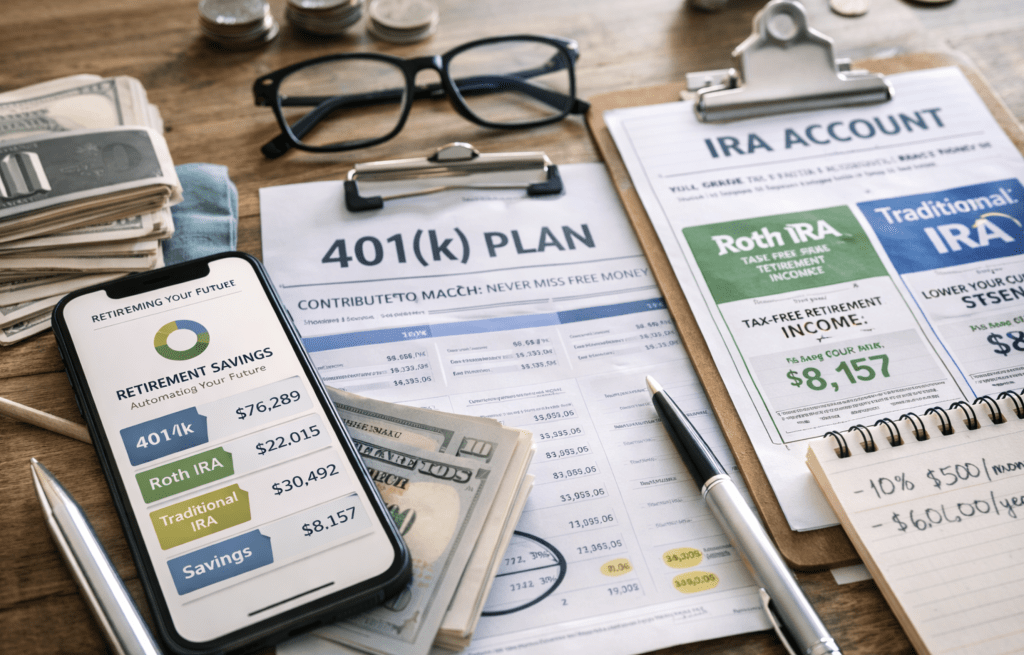
In your 30s, save 10–15% of your income for retirement. Start by getting every dollar of your 401(k) employer match—that’s free money with your name on it. Then open a Roth IRA (if you expect higher income later) or Traditional IRA (if you’re already in a high tax bracket). If you have a 401(k) from an old job, you can also roll it into an IRA so everything stays in one place—and it’s easier to automate. The real trick? Automate contributions directly from your paycheck. When the money never hits your spending account, you never miss it. With 30+ years of compound interest ahead, starting now beats starting later every single time.
Quick Takeaways
- Target 10–15% of gross income for retirement, even with mortgages, daycare, and debt competing for dollars.
- Never leave employer match money untouched; it’s the only guaranteed 50% or 100% return you’ll find.
- Choose Roth IRA if you expect higher future income; Traditional IRA if you’re already earning peak dollars.
- Automate transfers and use diversified portfolios that rebalance themselves, no market timing required.
- Consolidate old 401(k)s into one IRA—like a Finhabits IRA—to simplify tracking and keep your money actively invested.
The math of retirement is simple. The execution is what trips everyone up. You know compound interest works best with time. You understand tax-advantaged accounts exist. You’ve probably even calculated what you need to save.
Yet most people in their 30s save far less than they intend to. Not because they’re bad at math or irresponsible with money. Because between daycare pickups, work deadlines, and mortgage payments, retirement feels abstract while everything else feels urgent. The solution isn’t motivation; it’s removing yourself from the equation. Set up the right accounts, automate the right amounts, and let the system work while you handle actual life.
Watch: Start Your Retirement Plan in Minutes
See why investing for retirement matters and how automatic contributions work in this quick Finhabits walkthrough.
Why Does Your 30s Matter So Much for Retirement?
Every dollar you save at 32 has 35 years to compound before traditional retirement age. A dollar saved at 52 has just 15 years. That difference is massive. Save $300 monthly starting at 32, assuming 7% annual returns*, and you reach 67 with about $530,000. Start the same $300 monthly at 42, and you end with roughly $245,000. The ten-year head start more than doubles your outcome. (For illustration only. Returns are hypothetical and not guaranteed. Past performance doesn’t predict future results. Investing involves risk, including loss of principal).
This isn’t about shame if you haven’t started. Most 30-somethings haven’t saved what those “by age X” charts suggest they should have. Fine. What matters is what you do from today forward. Even starting from zero at 35, consistent automated savings can still build substantial wealth by retirement. The key is starting now with whatever amount you can manage, then increasing it as income grows.
How Much Should You Save for Retirement in Your 30s?
Use 10–15% of income as your starting target
The baseline: save 10–15% of gross income for retirement. This includes your contributions plus any employer match. Making $60,000? Ten percent equals $6,000 annually. If your employer matches 3% (that’s $1,800), you need to save $4,200 yourself, just $350 monthly, to hit the 10% mark. The employer match does part of the heavy lifting.
Turn a percentage into a paycheck amount
Percentages feel abstract until you translate them to actual paycheck deductions. At $50,000 annually, saving 10% means $192 from each biweekly paycheck. At $70,000 with a 12% savings rate, it’s $323 biweekly. These numbers might feel substantial right now. Start with 3–5% if needed, then schedule 1% annual increases until you reach your target.
Run your specific numbers through the Finhabits retirement calculator to see how different savings rates compound over your working years.
Which Accounts Should You Use: 401(k), Roth IRA, or Traditional IRA?
Step 1: Get your full 401(k) match
Employer matches are free money with your name on it. You earn $60,000, contribute 6% ($3,600), and your company matches half of that; suddenly your $3,600 becomes $5,400 invested. That’s an instant 50% return before any market gains. No investment strategy beats that guaranteed return. If you do nothing else, at least contribute enough to capture the full match.
For detailed comparisons of workplace plans versus individual accounts, read Finhabits’ breakdown of saving with a 401(k) plan versus an IRA.
Step 2: Choose Roth or Traditional IRA
Once you’re getting the full match, IRAs become your next move. The Roth versus Traditional decision boils down to taxes now versus taxes later. Roth IRA: pay taxes on contributions today, withdraw tax-free in retirement, ideal if you expect higher income later. Traditional IRA: potential tax deduction now, pay taxes on withdrawals later, better if you’re already in a high bracket.
Most people in their 30s lean Roth because they have decades of earning ahead. For specific guidance, check out Roth IRA explained simply and the comparison of Roth vs Traditional IRAs from Finhabits.
2026 Retirement Account Contribution Limits
| Account Type | 2026 Limit | Catch-Up (50+) |
|---|---|---|
| 401(k), 403(b), 457 | $24,500 | +$8,000 |
| Traditional IRA | $7,500 | +$1,100 |
| Roth IRA | $7,500 | +$1,100 |
Note: These limits are provided for general information and can change. Catch-up rules may vary by age and plan (for example, some plans allow higher catch-up contributions for ages 60–63). Contribution rules and eligibility can also depend on your income and tax situation. For the most current limits and details, confirm directly on the IRS website or with a qualified tax professional.
What Should You Do Next? A Simple 4-Step System
1. Pick a realistic savings percentage
Start where you can, not where you think you should be. Currently saving nothing? Begin with 5% and add 1% each year. Some experts suggest having one times your salary saved by 35, but if you’re nowhere close, dwelling on it won’t help. Action will. Even moving from 0% to 5% savings creates momentum that matters more than hitting arbitrary benchmarks.
2. Follow the account order
The hierarchy is straightforward: 401(k) to the match, then IRA to the annual limit, then taxable investment account for anything beyond. This maximizes free money first, tax advantages second, and long-term growth third. Following this order ensures you’re not leaving benefits on the table while chasing more complex strategies.
3. Automate everything you can
Manual transfers fail because life intervenes. Set up automatic pulls from your checking account or paycheck straight into your Finhabits retirement account. Schedule $200 every two weeks and you’ve invested $5,200 annually without thinking about it. When you get a raise, increase the automatic amount. The money never hits your spending account, so you never miss it.
4. Consolidate and simplify when needed
Those old 401(k)s from previous jobs? Consider rolling them into a single IRA (for example, a Finhabits IRA) so you have one place to track, automate, and stay invested. One login, one statement, one investment strategy to track. Multiple accounts scattered across providers guarantee you’ll lose track of something. Consolidation isn’t just convenient; it keeps your full retirement picture visible and your money actively working.
Why Should Automation Be Your Default?
The gap between knowing and doing kills more retirement plans than market crashes ever will. You know you should save. You know compound interest rewards patience. You know tax-advantaged accounts help. But knowing doesn’t deposit money into investment accounts.
Automation does. Set contributions to pull automatically. Choose diversified portfolios that rebalance themselves based on your risk tolerance. Remove the need for monthly decisions, quarterly reviews, or annual guilt about not saving enough. For the full case on why this matters, read long-term investing, automation, diversification, and time from Finhabits. The article connects today’s small automated moves to tomorrow’s financial independence.
Frequently Asked Questions
How much should I have saved for retirement by 35?
A common benchmark is having one to two times your annual salary saved by 35. Making $60,000? Aim for $60,000–$120,000 in retirement accounts. But don’t panic if you’re behind—starting now with consistent, automated contributions matters more than hitting an exact number. Even small amounts invested early can grow significantly over 30+ years.
Should I choose a Roth IRA or Traditional IRA in my 30s?
Most people in their 30s benefit more from a Roth IRA. Why? You pay taxes on contributions now (when you’re likely in a lower bracket) and withdraw tax-free in retirement (when your income may be higher). If you’re already at peak earnings, a Traditional IRA might make sense for the immediate tax deduction.
Is 10% enough to save for retirement?
10% is a solid starting point, but 15% is ideal if you can swing it. Remember: that 10–15% includes your employer match. If your company matches 3%, you only need to contribute 7–12% yourself to hit the target. Start where you can and increase by 1% each year until you reach your goal.
What’s the best order for retirement accounts?
Follow this sequence: (1) Contribute to your 401(k) until you get the full employer match—that’s free money. (2) Max out a Roth or Traditional IRA ($7,500 limit in 2026). (3) Go back to your 401(k) and contribute more, up to the $24,500 limit. (4) If you can save beyond that, use a taxable brokerage account.
What if I haven’t started saving for retirement yet?
Start today with whatever you can. Even $50 per paycheck is better than waiting until you can “afford” more. The power of compound interest means time in the market beats trying to time the market. Automate your contributions so saving happens without you having to remember or decide each month.
Connect Your 30s Plan with Finhabits
Setting up retirement savings in your 30s doesn’t require expertise in market analysis or tax law. It requires three things: the right percentage of income saved, the right accounts opened, and automation handling the execution. Finhabits provides the infrastructure; you just decide the amount.
Open a retirement investment account, connect your bank, schedule automatic transfers, and invest in diversified ETF portfolios with automatic rebalancing*. If you need help determining savings amounts or choosing between Roth and Traditional IRAs, Emma, Finhabits’ digital guide, walks you through the decisions at finhabits.com/emma. Once configured, your retirement plan runs in the background while you focus on everything else your 30s demand.
Sources
- Internal Revenue Service (IRS) – Retirement Plans
- Internal Revenue Service (IRS) – IRA Contribution Limits
All sources accessed and verified on January 7, 2026. External links open in a new window.
Disclaimer:
This material is provided for informational purposes only and is not intended to offer investment, legal, or tax advice. All images and figures are for illustrative purposes. Investment advisory services are offered through Finhabits Advisors LLC, a registered investment advisor with the SEC. Registration does not imply a certain level of skill or training. Past performance is not indicative of future returns. All investments involve risk, including the possible loss of principal. Securities are offered through Apex Clearing Corporation, Member of FINRA, SIPC. Securities held at Apex are protected up to $500,000, which includes a $250,000 cash limit. See SIPC.org for more details.
Before opening a retirement account, ROTH IRA, or Traditional IRA, you should carefully consider your own situation and personal preferences. Factors to consider when evaluating the opening of a ROTH IRA or Traditional IRA account include: investment options, fees and expenses, services, withdrawal penalties, creditor and legal protections, required minimum distributions, and the treatment of employer stock (in the case of a rollover). Finhabits does not provide tax advice. Please consult with a tax professional.
© Finhabits, Inc. All rights reserved.