

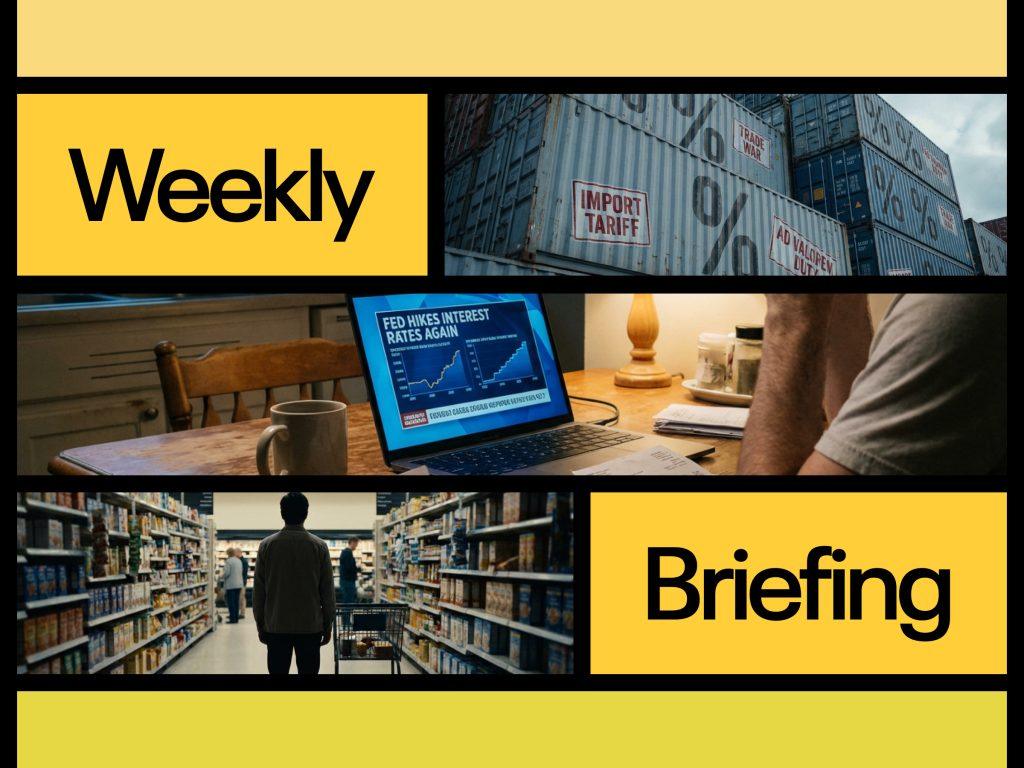
Before we look ahead to 2026, it’s worth pausing for a moment to reflect on what the year we just left behind actually taught us.
One of 2025’s most consistent lessons was how hard it is to predict markets—even when the setup looks “clear.” Many 2026 outlooks share the same baseline narrative—moderate growth, better-controlled inflation, and continued corporate earnings gains—but the fact that forecasts still diverge so widely is a reminder of how fragile any prediction can be.
That tension between optimism and caution wasn’t limited to the forecasts. In many ways, it was the defining thread of 2025 itself.
Let’s start with the three macro themes that dominated the headlines in 2025.
Trade policy and tariffs: the return of political shock
Donald Trump’s return to the White House put trade policy back at the center of the economic conversation. Announcements and threats of new tariffs stopped being campaign noise and became a real factor shaping inflation expectations, investment decisions, and business confidence. Over the course of the year, the focus shifted: it wasn’t just whether tariffs would happen, but how costly they would be, how long they might last, and what they could do to supply chains, prices, and consumer demand.
Why it matters:
Tariffs often function like an indirect tax on imported goods and components. That can put upward pressure on prices, squeeze corporate margins, and ultimately influence the pace of growth.
What it means for your money:
In practical terms, a more aggressive tariff environment can show up as higher prices in exposed categories—think electronics, cars, and household goods—and more market “noise,” because every new headline can reset expectations for inflation and interest rates. For most investors, the most useful response is to avoid news-driven decisions, make sure your portfolio is properly diversified, and stick with a long-term plan that doesn’t depend on guessing the next political turn.
Inflation, rates, and the Federal Reserve: the constant back-and-forth
Inflation remained the economic and political thermometer of 2025. At times it surprised to the upside; at others, it showed signs of cooling. That mixed pattern kept the spotlight on the Federal Reserve for months and fueled constant headlines about when—and how much—rates could come down. When cuts finally arrived, the message stayed cautious: some relief, yes, but no “victory lap.”
Why it matters:
Interest rates touch almost everything: mortgages, auto loans, credit cards, business borrowing—and also the yields on more conservative options like savings accounts and fixed income.
What it means for your money:
If you carry variable-rate debt, a cutting cycle can provide some breathing room, but if your rates are fixed, the impact tends to show up later—when you refinance or renew. At the same time, shifting expectations around the Fed can move bond prices and stock valuations sharply, even if nothing about your personal situation has changed. That’s why the most valuable approach is usually the simplest: prioritize paying down high-interest debt, keep your contributions consistent, and avoid chasing “rate timing” as if it were a sure thing.
The consumer: resilient spending, weaker sentiment
Consumer behavior was one of the year’s biggest contradictions. On one hand, Black Friday and Cyber Monday delivered record online sales. On the other, consumer confidence weakened noticeably toward year-end. People kept spending—but with more caution and more concern about what comes next.
Why it matters:
The consumer is a core engine of the economy. When sentiment weakens for an extended stretch, it can signal slower spending ahead, cooler growth, and in some cases, shifts in the job market.
What it means for your money:
A more cautious consumer often pushes companies to be more conservative, which can show up in hiring, raises, and income stability in certain sectors. Personally, this kind of environment rewards preparation: strengthening your emergency fund, trimming fixed costs that don’t add real value, and keeping a tight grip on your monthly budget. This isn’t about panic—it’s about building margin and clarity so your plan doesn’t depend on everything going perfectly.
Other stories that shaped the headlines
Government shutdown: when the economy went “dark”
The federal government shutdown was disruptive not just because it was political, but because it interrupted services, delayed official reports, and distorted the release calendar for key economic data. For weeks, markets, businesses, and even the Fed had to operate with incomplete information.
What it means for your money:
When data goes missing, uncertainty rises—and markets tend to react more to headlines than fundamentals, which can amplify short-term swings. The practical takeaway is straightforward: don’t make major financial decisions “in the dark” because of a volatile week, and instead lean on your plan—diversification, steady contributions, and a long-term horizon—when the information landscape gets messy.
Markets at record highs… with clear signs of hedging
Stocks hit new highs supported by corporate resilience and expectations for lower rates. But that optimism ran alongside clear caution: more hedging activity, more attention to safe-haven assets, and extreme sensitivity to headlines about trade, inflation, or monetary policy.
What it means for your money:
A market at record highs isn’t the same as a risk-free market—sharp pullbacks can happen even in strong years. That’s why what protects your progress most is the process: investing consistently (ideally automated), maintaining an allocation that fits your risk profile, and avoiding big swings in strategy driven by fear or euphoria.
Energy and geopolitics: oil as a risk gauge
Oil prices swung between global slowdown fears and episodes of geopolitical tension. The energy market once again reminded investors how quickly conflict can translate into real-world prices and shifting expectations.
What it means for your money:
Energy affects your day-to-day budget through gas, transportation, and logistics costs, and it can also influence broader inflation because it raises the cost of moving and producing goods. For your finances, this reinforces a simple principle: leave room for variability in your monthly budget and avoid locking yourself into fixed expenses so tight that one moving piece—like energy—throws everything off.
China and global slowdown: the other shadow
China resurfaced repeatedly in headlines due to weak demand signals, industrial pressure, and trade tensions. Its growth pace affects the global economy, commodity prices, and supply chains.
What it means for your money:
When global growth slows unevenly, some sectors and companies feel the impact more than others, and that shows up in international markets—especially among businesses with global exposure. For investors, this brings one basic but powerful idea back to the forefront: diversification isn’t theoretical—it’s a practical way to avoid relying on a single country, sector, or narrative to keep moving forward.
Final thoughts
Starting 2026 with clarity matters more than starting it with certainty.
Uncertainty—and even contradiction—across forecasts isn’t a flaw in markets. It’s part of how complex economic systems work. The lesson for the year ahead is simple: for the average investor, the real value isn’t in picking the “right” prediction—it’s in building a strategy that holds up across scenarios.
Diversification, a long-term horizon, and consistency tend to matter far more than reacting to every headline. That’s the lens we’re bringing into 2026 at Finhabits: less noise, more context, and decisions built for the long run.
Disclaimer:
This material is provided for informational purposes only and is not intended to offer investment, legal, or tax advice. All images and figures are for illustrative purposes. Investment advisory services are offered through Finhabits Advisors LLC, a registered investment advisor with the SEC. Registration does not imply a certain level of skill or training. Past performance is not indicative of future returns. All investments involve risk, including the possible loss of principal. Securities are offered through Apex Clearing Corporation, Member of FINRA, SIPC. Securities held at Apex are protected up to $500,000, which includes a $250,000 cash limit. See SIPC.org for more details.
© Finhabits, Inc. All rights reserved.
Sources
- Finhabits — Can we predict the stock market for 2026?
- Reuters — End of U.S. government shutdown won’t lift economic fog
- AP (via Yahoo News!) — Stocks edge lower as 2025 winds down while gold and silver rise
- The Budget Lab —Where We Stand: The Fiscal, Economic, and Distributional Effects of All U.S. Tariffs Enacted in 2025 Through April 2
- Financial Times — Russia’s oil industry could suffer long-term damage from Ukrainian drone attacks
- Reuters — China factory activity expected to shrink…
- AP News — Shoppers spend billions on Black Friday 2025
- Reuters / Adobe Analytics — Thanksgiving–Cyber Monday y Cyber Monday 2025
- The Conference Board — Consumer Confidence Index


