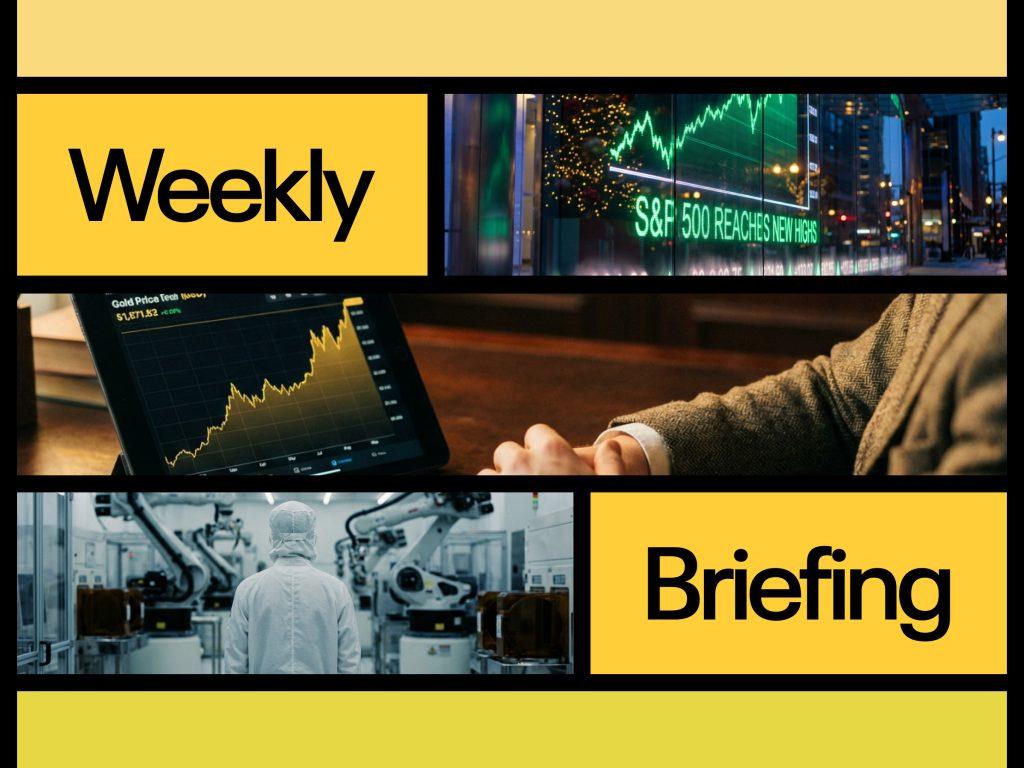
Markets closed the pre-holiday week on a confident note, but the underlying picture remained layered. U.S. stocks pushed to new highs in thin trading, supported by optimism around a potential “Santa rally” and expectations that the Federal Reserve could cut rates in 2026. At the same time, investor behavior signaled caution: gold and other precious metals surged to record levels, oil prices extended a multi-day rally on geopolitical risks, and consumer confidence softened. Trade policy also returned to the spotlight, with the U.S. delaying new tariffs on Chinese semiconductors—another reminder that momentum and uncertainty are coexisting as the year comes to a close.
This week’s briefing breaks down the most important developments—and what they may mean for everyday finances.
S&P 500 hit a record as the “Santa rally” took shape
The S&P 500 reached a new intraday record during a shortened pre-holiday session, lifted by broad-based buying and optimism that the Fed could continue easing monetary policy in 2026. With many institutional investors already away for the holidays, lighter trading volumes likely amplified price moves. Still, the rally reflected confidence that inflation pressures are easing and that economic growth, while slowing, remains resilient enough to support corporate earnings.
At the same time, record highs arrived alongside mixed economic signals. Consumer confidence weakened, and investors simultaneously bid up safe-haven assets—suggesting enthusiasm in equities may have been driven as much by expectations and liquidity as by a uniformly strong economic outlook.
Why it matters:
Market records can feel reassuring, but they don’t eliminate risk. Strong rallies can coexist with underlying fragility.
What this means for your money:
- Don’t chase performance just because markets reached new highs.
- Diversification remains essential when optimism and caution rise together.
Gold surged past $4,500 as caution surfaced beneath the rally
Gold jumped above $4,500 an ounce, with silver and platinum also closing at record levels. The move reflected a clear “risk-off” undercurrent: investors positioned for lower interest rates in 2026 while hedging against geopolitical tensions, trade uncertainty, and potential economic slowdowns. Historically, this kind of divergence—stocks rising while safe havens rally—often points to uncertainty about how durable current growth may be.
Unlike short-lived speculative spikes, the move in precious metals was steady and broad, reinforcing the idea that investors were seeking balance rather than abandoning risk altogether.
Why it matters:
When safe-haven assets rise alongside stocks, markets are sending a more cautious signal than headlines alone suggest.
What this means for your money:
- Diversification isn’t just about returns—it’s about resilience.
- Precious metals can play a defensive role, but they shouldn’t dominate a portfolio.
U.S. delayed new tariffs on Chinese chips until 2027
The U.S. administration announced a delay of new tariffs on Chinese semiconductors, keeping rates at zero for roughly 18 months. The move signaled a more calibrated approach to trade tensions, aimed at avoiding additional inflationary pressure or supply-chain disruptions at a sensitive moment for the global economy. While the delay reduced near-term risk, it did not resolve longer-term strategic competition in technology.
Markets interpreted the decision as a stabilizing signal, particularly for manufacturers and industries sensitive to input costs.
Why it matters:
Trade policy directly influences prices, inflation, and corporate investment decisions.
What this means for your money:
- Reduced near-term tariff pressure may help limit price increases.
- Policy delays ease stress, but uncertainty remains.
Other news
Oil prices rose for a sixth straight session
Brent and WTI crude extended gains for a sixth consecutive session, supported by geopolitical risks and concerns about supply disruptions, alongside solid U.S. growth data.
What it means for your money: Higher energy prices can feed into transportation, food, and utility costs.
BP sold a majority stake in Castrol for about $6 billion
BP agreed to sell 65% of its Castrol business to Stonepeak, valuing the unit at roughly $10.1 billion as part of a broader effort to reduce debt and streamline operations.
What it means for your money: Corporate balance-sheet moves can reshape sector dynamics and long-term returns.
U.S. consumer confidence weakened in December
A key measure of consumer confidence declined, reflecting concerns about job security and income growth despite strong equity markets.
What it means for your money: Softer sentiment may translate into more cautious household spending.
U.S. GDP surprised to the upside in the third quarter
Economic growth came in stronger than expected, reigniting debate over whether the economy is heading toward a soft landing or simply delaying a slowdown.
What it means for your money: Strong growth supports markets but may delay rate cuts.
European stocks paused after a strong year
European markets traded sideways near record levels, closing out a solid year as investors positioned for lower interest rates in 2026.
What it means for your money: Geographic diversification helps reduce reliance on a single market cycle.
Japan signaled potential momentum toward higher rates
Hawkish comments from the Bank of Japan revived expectations of another rate hike, with ripple effects for the yen and global capital flows.
What it means for your money: Currency shifts can affect international investments.
Global trade ended 2025 with elevated uncertainty
A year marked by waves of tariffs and negotiations left trade policy as a lingering risk heading into 2026.
What it means for your money: Trade uncertainty can keep pressure on prices and supply chains.
Final thoughts
As 2025 comes to a close, one message stands out: markets may be ending the year strong, but uncertainty hasn’t disappeared. While stocks have reached new highs, other signals—such as weaker consumer confidence, global trade tensions, and increased demand for safe-haven assets—suggest caution remains part of the picture.
This isn’t a contradiction; it’s how this stage of the cycle works. Optimism and prudence often move together, with markets looking ahead while households and businesses reassess risks and priorities. Rather than reacting to individual headlines, this is a moment to step back and focus on what you can control.
Use this year-end pause to review your financial plan, align priorities with your family, and make small adjustments that prepare you for different scenarios in 2026. Reviewing your plan now can make a meaningful difference in how you start the year ahead.
Sources:
- Reuters- S&P 500 hits record as Santa rally optimism builds
- CNBC- Gold breaks above $4,500 as investors seek safety
- The Wall Street Journal- U.S. delays new tariffs on Chinese semiconductors until 2027
Reuters- Oil prices rise on geopolitical risk and supply concerns - Finance Yahoo!- BP sells majority stake in Castrol in $6 billion deal
- PBS- Consumer confidence drops in December to lowest level since U.S. tariffs rolled out in April
- CBS News- U.S. third-quarter GDP revised higher
- Bloomberg- European Stocks Rise to Record; Novo Rallies on US Approval
- CNBC- Japan interest rates hit highest in 30 years
- U.S. News- Trump Shook up Global Trade This Year; Some Uncertainty May Persist in 2026