Market volatility is how much and how quickly the price of an investment moves up or down. It’s a normal feature of markets: they react constantly to economic data, company earnings, technological developments, and political events. Volatility can’t be eliminated, but it can be managed with the right time horizon, long-term investing, and a portfolio built through portfolio diversification.
How does AI news affect my investments? (Spoiler: it’s not the only cause)
On September 14, 2026, AI-related and semiconductor stocks pulled back across several markets, after Dario Amodei, CEO of Anthropic, published a public call to moderate the pace of AI development (Amodei, 2026; CNBC, 2026). The move was also influenced by concerns about data center infrastructure spending and the sector’s debt levels.
But that wasn’t the only thing going on. At the same time, the market was also processing signals about interest rates, inflation expectations, oil prices, and geopolitical tensions. Market movements rarely have a single cause, even though headlines almost always pick one to explain it.
Heads up: this wasn’t an “AI crash.” It was the market doing what it always does — reacting to new information.
Why does the stock market go up and down? Beyond a single headline
The price of a stock, a fund, or any investment changes because the market is constantly adjusting its expectations based on new information. Some of the factors that matter most:
- Economic: inflation, employment, interest rates, spending, growth.
- Company-specific: earnings, guidance, leadership changes, product launches.
- Technological: artificial intelligence, automation, and other developments that can change the growth or competitive landscape of an industry.
- Political and geopolitical: elections, new policies, regulation, trade disputes, conflicts.
- Social: demographic shifts, changes in consumer behavior.
- Environmental: natural disasters, extreme weather, energy or supply chain disruptions.
Here’s what matters: an initial market reaction to a piece of news doesn’t necessarily predict what happens long term.
What’s the difference between risk and volatility? The mix-up that costs people money
Here’s the distinction that’s worth understanding well.
Volatility describes how quickly and how much an investment’s price changes. A volatile asset can move up and down frequently, and that alone doesn’t tell you whether it’s a good or bad investment.
Risk is broader. It includes the possibility of permanently losing money, of not reaching a financial goal, or of having to sell an investment right when its value is down.
A volatile investment could still deliver strong long-term results. The problem shows up when someone needs that money right during a downturn.
And this is where time horizon comes in:
- Money you need soon has less time to recover from a downturn.
- Money invested toward a long-term goal moves through multiple market cycles.
- A longer horizon doesn’t eliminate risk or guarantee you’ll recover what you lost.
- Your portfolio should match your goals, your circumstances, and how long you plan to stay invested.
What history says about long-term investing: a century of data, no straight line
Since its launch on March 4, 1957, the S&P 500 has had an annualized price return of around 7%, and a 10% annualized total return over the same period — the difference is reinvested dividends (S&P Dow Jones Indices, n.d., p. 5). Both figures are nominal: they aren’t adjusted for inflation. Historically, the U.S. stock market has grown over long periods, but never in a straight line.
Before using this figure as a reference, keep in mind:
- It’s a long-term annualized return, not what you’d earn in any single year.
- Annual returns have varied widely, and have often been negative.
- The difference between 7% and 10% is reinvested dividends; both figures are nominal, not adjusted for inflation.
- The S&P 500 represents large U.S. companies — not the entire market, and not any specific portfolio.
- Past performance doesn’t guarantee future results.
This doesn’t mean the market will recover within any set time frame, or that your money will grow at that same rate. It just shows that long-term growth and short-term volatility can coexist.
That long-term growth largely comes down to compound interest: the process by which your earnings generate new earnings over time.
How to reduce risk when investing in a volatile market? The mistake that turns a dip into a loss
Here’s one of the most important lessons in investing: when the market drops, fear leads many people to sell right after the price has already fallen. Selling can turn a possible loss into a confirmed loss, and it can leave you out of the market when it eventually recovers.
This doesn’t mean “stay invested no matter what” is always the right answer. If your goals, your time horizon, or your financial situation have genuinely changed, revisiting your strategy makes sense. The difference is between making a decision based on a plan, and reacting out of fear to a headline.
Expecting volatility before it happens makes it easier to respond according to a plan instead of out of fear.
Diversification: what it means to have a diversified portfolio (and why it’s not magic)
You’ve seen what you can’t control: when the market moves, and why. Now let’s talk about what you can control.
Diversifying means spreading your money across different companies, industries, markets, or asset types, instead of depending on just one. Someone who only holds AI or semiconductor stocks is much more exposed to whatever happens in that specific industry. In a diversified portfolio, those same companies are just one part of a bigger mix.
Not every investment moves the same way at the same time, and that’s where the value of diversifying comes from. But it’s important to be clear about what diversification does and doesn’t do:
A diversified portfolio:
- Can reduce your dependence on a single company, industry, or trend.
- Can help manage your portfolio’s overall volatility.
A diversified portfolio does NOT:
- Guarantee gains.
- Prevent all losses.
- Eliminate volatility.
In a broad market downturn, several asset classes can drop in price at the same time. Diversifying helps manage your exposure — it doesn’t make you immune to what’s in the headlines.
How to diversify my investments without picking individual stocks? The short answer: ETFs
An ETF (exchange-traded fund) is a fund that pools together a collection of investments, like stocks or bonds.
When you buy a share of the fund, you get exposure to that entire collection of investments, not just one company. ETFs pool money from many people and make it possible to own a portion of many different investments through a single purchase. That’s why they’re a practical way to diversify without picking stocks one by one.
Here’s the catch: not every ETF is diversified on its own. Some hold thousands of investments; others concentrate in a single sector, country, strategy, or even one company. How diversified you are depends on what each ETF holds, and how you combine several of them within a complete portfolio.
And like any investment, an ETF isn’t free of costs or risk: it can carry fees, it’s exposed to overall market risk, it can carry concentration risk if it tracks a specific sector, and its performance can differ slightly from the index it follows (Investor.gov, 2026). Before investing in any ETF, it’s worth reviewing its prospectus and fund summary.
Diversification is every investor’s secret weapon
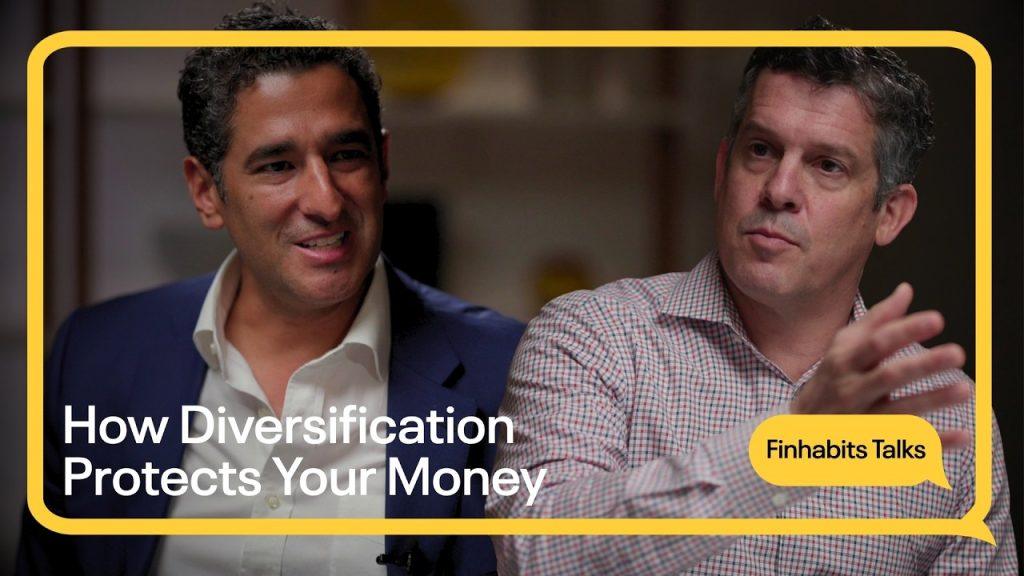
Want to know exactly how an ETF groups different investments to diversify your portfolio without having to pick stocks one by one? In this video, Carlos García, CEO and founder of Finhabits, speaks with Vanguard’s Chris Tidmore, CFA, about the advantages of diversification:
Invest consistently, don’t react to headlines: discipline beats timing
Investing success depends more on consistency than on getting the timing exactly right. Investing a set amount every week, every two weeks, or every month — a practice known as dollar-cost averaging — can help you:
- Build the habit.
- Keep making progress toward a long-term goal.
- Avoid making each contribution depend on predicting the market.
- Buy at different prices over time.
This doesn’t guarantee gains or protect you from losses.
In fact, in a market that’s rising steadily, investing all your money at once could perform better than investing it little by little over time (Investor.gov, n.d.). The advantage of investing consistently isn’t maximizing returns in every scenario — it’s taking the pressure off deciding “when” to invest.
This also isn’t the moment to invest extra money just because prices dropped. Whether it makes sense to contribute more depends on your full financial picture: your emergency fund, your debts, your goals, and how much volatility you’re comfortable with.
This is how Finhabits builds portfolios
This is also how Finhabits builds its portfolios: using ETFs to spread investments across multiple companies and asset classes. The goal isn’t to eliminate fluctuations — it’s to keep a portfolio from depending on the performance of a single company, industry, or headline.
That’s why we recommend a portfolio based on your financial profile. No portfolio is right for everyone, and no recommendation removes the possibility of loss.
Markets are going to keep reacting to AI, to economic data, and to events we can’t predict. A long-term strategy doesn’t depend on anticipating every headline. Start with the right time horizon, consistent contributions, and a diversified portfolio.
Sources
- Dario Amodei, “We Must Pace the Frontier” (2026)
- CNBC: Top 10 things to watch in the stock market
- Investor.gov: Exchange-Traded Funds
- Investor.gov: Dollar-Cost Averaging
Disclaimer:
This material is provided for informational purposes only and is not intended to offer investment, legal, or tax advice. All images and figures are for illustrative purposes. Investment advisory services are offered through Finhabits Advisors LLC, a registered investment advisor with the SEC. Registration does not imply a certain level of skill or training. Past performance is not indicative of future returns. All investments involve risk, including the possible loss of principal. Securities are offered through Apex Clearing Corporation, Member of FINRA, SIPC. Securities held at Apex are protected up to $500,000, which includes a $250,000 cash limit. See SIPC.org for more details.
© Finhabits, Inc. All rights reserved.