

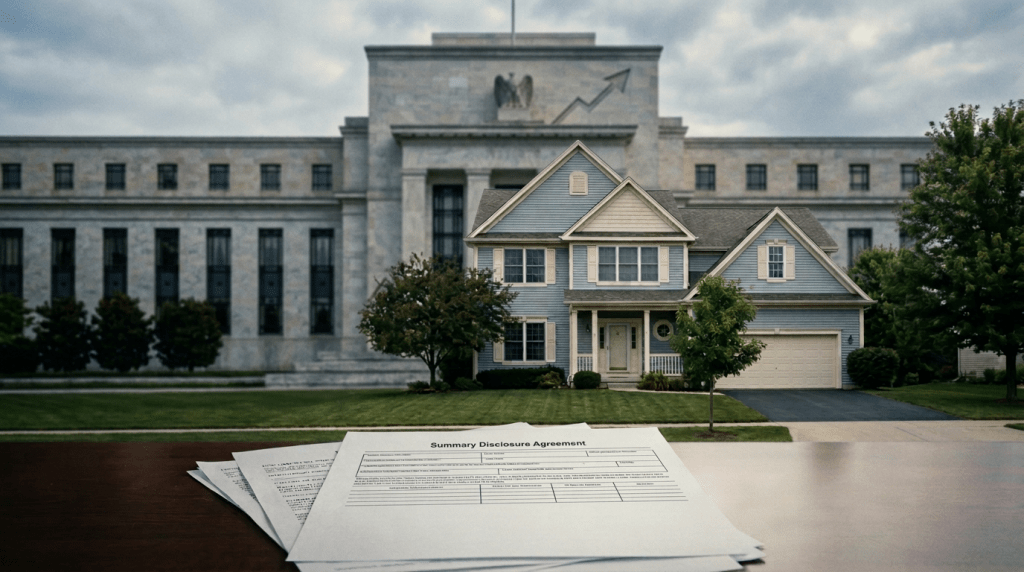
The Federal Reserve raised its benchmark rate by 0.25 percentage points, to a target range of 3.75%–4.00% — its first increase since July 2023. Inflation, in the Committee's words, "remains elevated," still above the Fed's 2% goal.
Headlines move fast. Your money doesn't have to.
Whenever the Fed meets, the same question shows up at the kitchen table: does this mean my credit card, my mortgage or my car payment just went up?
The short answer is the one worth remembering long after this week's news cycle:
Understanding that difference is what lets you read the next headline calmly, whether the Fed raises rates, lowers them or leaves them where they are.
What rate does the Fed actually change?
The rate the Fed sets is the federal funds rate — a target range for what banks charge each other for very short-term loans, typically overnight.
That's it. It is a rate between banks, not a rate on your statement.
The Fed uses that single lever because it sits at the base of the system. When the cost of short-term money between banks moves, it tends to ripple outward: into what banks pay for deposits, what lenders charge for credit, what investors expect from bonds. But "ripple outward" is doing a lot of work in that sentence. The signal reaches different products:
- at different speeds — some in a billing cycle or two, others over months
- at different sizes — a quarter-point move by the Fed rarely becomes a quarter-point move in your APR
- and sometimes in unexpected directions, because other forces are pushing at the same time
So when you hear "the Fed raised rates," the accurate translation isn't my rates went up. It's the price of money in the system shifted, and the products I use may respond in their own way.
Why does the Fed use interest rates to fight inflation?
The mechanism is easier than it sounds.
How a rate increase is meant to work
With lags, and not for every price.
Lower rates generally work in the opposite direction.
Three things are worth holding onto here, because they get lost in headlines:
- The effect isn't immediate. Monetary policy works with lags — changes made today may take many months to show up in prices.
- Not every price responds the same way. Rent, groceries, gas and services each have their own dynamics, and some barely respond to interest rates.
- Raising rates does not automatically bring inflation down. It's one tool among many forces — supply chains, energy, wages, global conditions — acting on prices at the same time.
That's why the Fed talks about moving toward its 2% goal rather than promising a date.
What can happen with credit cards?
Credit cards are usually the fastest to respond, and here's why: most carry variable rates tied to the prime rate, which generally moves alongside the federal funds rate. When the environment shifts, card issuers may adjust variable APRs within a billing cycle or two.
But it helps to separate four different things that often get mixed together:
- The rate environment — what the Fed and the broader market are doing.
- Your APR — the rate your issuer actually applies to your account, which depends on your agreement, your credit profile and the issuer's own decisions.
- Your balance — how much you're carrying from month to month. This is the part you have the most influence over.
- Time — the longer a balance stays unpaid, the more the cost of carrying it compounds, at whatever rate applies.
Here's the part that tends to surprise people: for most households, the balance matters more than the headline. A quarter-point change in the environment is small next to what a revolving balance costs month after month.
Take a hypothetical case of someone carrying about $5,000 on a credit card. A small change in the rate environment might shift the monthly interest by a few dollars. Paying down a meaningful piece of that $5,000 — or moving from minimum payments to a structured plan — generally changes the math far more. (This is a hypothetical example for illustration purposes. Actual costs vary depending on your APR, your balance and your issuer's terms.)
If you're carrying a balance, this is the lever worth pulling regardless of what the Fed does next. Our guide on how to pay off credit card debt and save at the same time walks through how to order your balances by interest rate and set a pace you can keep.
What happens to mortgage rates?
This is where the confusion is most common, so let's be direct: the Fed does not set mortgage rates.
This week offers a clean illustration. The Fed raised its benchmark by 25 basis points. Over roughly the same stretch, Freddie Mac's survey showed the average 30-year fixed-rate mortgage go from 6.76% to 6.95% — a move of 19 basis points.
Close, but not the same. And that's the point:
Fed +25 bp ≠ mortgage +25 bp
Mortgage rates are priced in the bond market. They tend to track the behavior of longer-term yields — Treasuries and mortgage-backed securities — which respond to a wider mix of forces:
- expectations about inflation over the coming years, not just today
- expectations about where the Fed is heading next
- the spread lenders and investors require for risk
- supply and demand for mortgage bonds
- broader financial and economic conditions
Because markets often price in what they expect before a decision is announced, it's possible to see the Fed raise its rate while mortgage rates hold steady — or even fall — if expectations shift at the same time. The reverse can happen too.
If you're shopping for a home or thinking about refinancing, this is useful rather than discouraging: mortgage rates have their own logic, so it's worth comparing offers across lenders on their own terms instead of timing a single Fed meeting.
What happens with car loans?
Here the key distinction is between the loan you already have and the one you might take out.
An existing fixed-rate auto loan. If your rate is fixed, it generally doesn't change because the Fed moved. Your payment was set when you signed. That's part of what a fixed rate is for.
New financing. The general rate environment can influence what offers are available — but your actual APR depends on factors closer to home:
- your credit score and credit profile
- the loan term you choose
- your down payment
- the vehicle itself (new or used, model year)
- the lender, and any manufacturer promotions in the market
Two people walking into the same dealership the same week can be quoted meaningfully different rates. That's not the Fed — that's the profile and the terms.
What happens to your savings?
Rates cut both ways, and this is the side that often gets less attention.
A higher-rate environment can favor better yields on some savings vehicles:
- savings accounts
- certificates of deposit (CDs)
- money-market deposit accounts
- other short-term instruments
But the same caution applies in reverse:
Fed +25 bp ≠ savings account +25 bp
Each institution decides what it offers, based on its own funding needs and competitive position. Some move quickly; others take their time or don't move much at all. Deposit rates tend to be slower to rise than credit rates — which is worth knowing, because it means the benefit isn't automatic.
If your savings are sitting somewhere that hasn't moved in a while, a rate environment like this one is a reasonable moment to compare what's available. Not to chase, just to check.
What happens to your investments?
Markets do react around Fed decisions — but not in a way that translates neatly into "rates up, markets down."
Prices move in response to a mix that includes:
- the decision itself
- what the market had already priced in beforehand
- inflation data
- economic growth
- Treasury yields
- corporate earnings
- expectations about what the Fed may do at future meetings
That last one matters more than people expect. If the market anticipated a move, much of it may already be reflected in prices before the announcement. Sometimes the reaction comes from the tone of the statement rather than the number.
Which is why a single Fed meeting is a poor reason to change a long-term plan. For money invested with a horizon of years — retirement, a child's future, generational wealth — the relevant question generally isn't what happened this Wednesday afternoon. It's whether you're still contributing consistently and staying diversified through the noise.
Volatility is part of investing. A plan that only works when the news is calm isn't really a plan.
Bringing it back to your finances
You don't need to track every Fed meeting. What's useful is knowing which parts of your own situation are actually sensitive to rates — and which aren't.
Depending on your situation, here's what's worth a look:
| What to review | Why |
|---|---|
| Variable-rate debt and your APR | Credit cards and other variable products tend to respond fastest to the rate environment. |
| Credit card balances | The balance you carry usually affects your cost more than a quarter-point move does. |
| Existing fixed-rate loans | These generally don't change with Fed decisions — one less thing to worry about. |
| The cost of financing a home or car | If you're about to borrow, compare offers on their own terms rather than on the headline. |
| What your savings are earning | Institutions set their own rates. Worth checking what yours is paying. |
| Your long-term investment strategy | Built for years, not for one meeting. Consistency tends to matter more than timing. |
If credit card balances showed up on that list for you, that's the highest-leverage place to start. Our guide on eliminating credit card debt and where to put the money you free up breaks it into steps you can begin this month.
And the next time a Fed headline appears, you'll be able to read it for what it is: useful context about the environment — not an instruction about your money.
Frequently asked questions
Does my credit card APR go up the day the Fed raises rates?
Not that same day. Many cards carry variable rates tied to prime, which generally moves alongside the federal funds rate, so the adjustment can show up within a billing cycle or two. Your card agreement spells out how and when.
Did the Fed raise mortgage rates?
No. The Fed sets the federal funds rate. Mortgage rates are priced in the bond market and respond to a wider set of forces, so they can move by a different amount — or in a different direction.
Will my savings account pay more now?
Possibly, though it isn't automatic. Each institution decides what it offers, and deposit rates often move more slowly than borrowing rates.
Should I change my investments because of a Fed decision?
A single meeting is generally a weak basis for changing a long-term strategy. Markets respond to many factors at once, and much of an expected decision may already be reflected in prices. Consider talking with a qualified financial professional about your specific situation.
Sources
- Federal Reserve — FOMC statement, September 16, 2026
- Federal Reserve — Summary of Economic Projections
- Freddie Mac — Primary Mortgage Market Survey (September 17, 2026)
This content is prepared and reviewed by the Finhabits team to ensure clarity and accuracy. It is intended for educational purposes only.
Disclaimer:
This material is provided for informational purposes only and is not intended to offer investment, legal, or tax advice. All images and figures are for illustrative purposes. Investment advisory services are offered through Finhabits Advisors LLC, a registered investment advisor with the SEC. Registration does not imply a certain level of skill or training. Past performance is not indicative of future returns. All investments involve risk, including the possible loss of principal. Securities are offered through Apex Clearing Corporation, Member of FINRA, SIPC. Securities held at Apex are protected up to $500,000, which includes a $250,000 cash limit. See SIPC.org for more details.
© Finhabits, Inc. All rights reserved.