Today, plenty of apps let you buy stocks from your phone, often in just a few taps. But buying a stock on your own is very different from following a diversified, long-term strategy: the goal, time horizon, risk, and way you make decisions all change. Here’s how trading differs from long-term investing, how much time each approach takes, and whether you need to pick individual stocks to get started.
Trading vs. Long-Term Investing: Two Ways to Put Your Money to Work
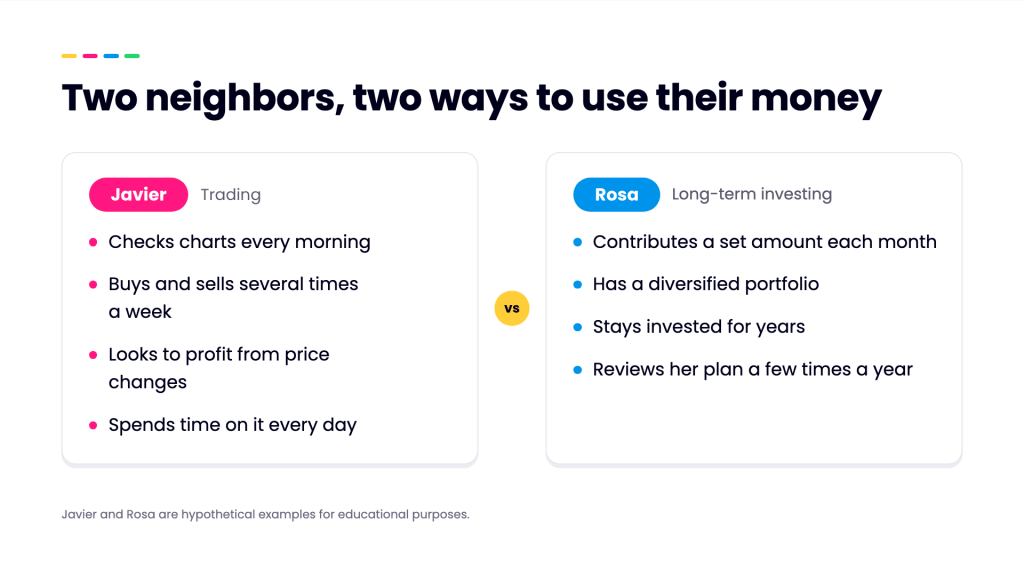
Imagine two neighbors, Javier and Rosa. They each run a small business and want their money to grow.
Javier picks stocks on his own using an app. He checks charts before opening his business, buys and sells several times a week, and looks to profit from price changes.
Rosa contributes to a diversified portfolio each month and reviews it a few times a year.
Each approach asks different things of you:
| Factor | Javier: Trading | Rosa: Diversified Long-Term Investing |
|---|---|---|
| Goal | Profit from price changes over a short period. | Give her money a chance to grow over the years. |
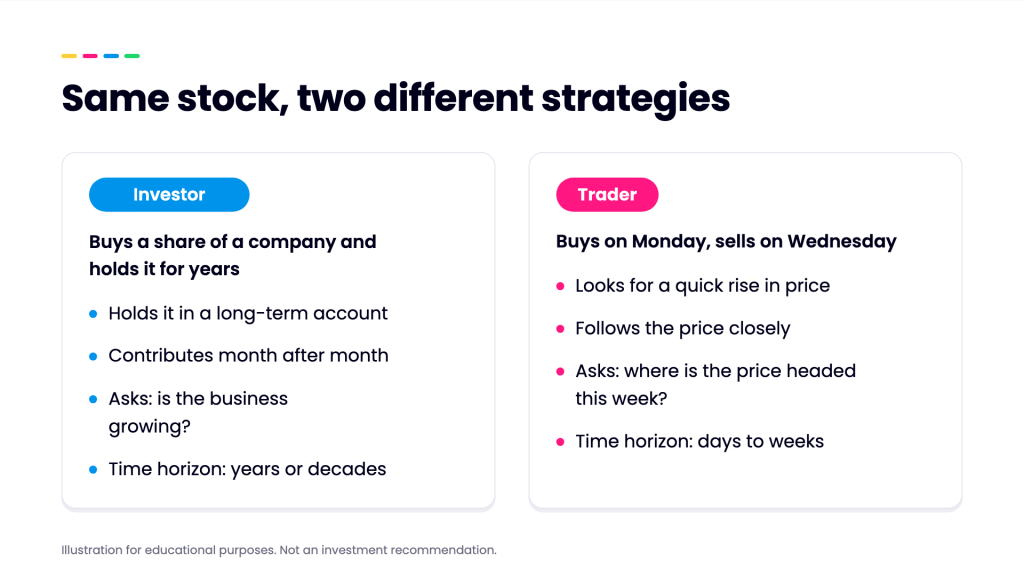
| Time horizon | Days, weeks, or months. | Years or decades. |
| Frequency | Several trades per week. | One contribution per month. |
| Time commitment | Following the market almost every day. | Reviewing the plan a few times a year. |
| How decisions are made | Price, trends, and news. | Goals, time horizon, and risk tolerance. |
| Costs | Possible commissions, the difference between buying and selling prices, and taxes on each sale at a gain. | Fund expenses or management fees. |
| Risks | Rapid losses, decisions under pressure, and reliance on a few companies. | Market downturns that can last, or needing the money sooner than planned. |
Trading means being ready to react quickly, and some people develop skill with practice. But doing it well takes time, discipline, and the ability to handle losses. Long-term investing takes patience to stick with the plan when the market drops. Neither approach guarantees gains.
In the U.S., gains on investments you held for one year or less are generally taxed as ordinary income. Tax rules can vary depending on your situation.
Day trading, buying and selling on the same day, is just one type of trading. Javier isn’t day trading.
What’s Behind a Stock
Buying a share of stock means buying a small piece of a company. Before you do, it helps to understand:
- What the company sells and how it makes money.
- Whether its revenue is growing and whether it’s profitable yet.
- Who its competitors are.
- How much it owes.
- The risks the company itself discloses.
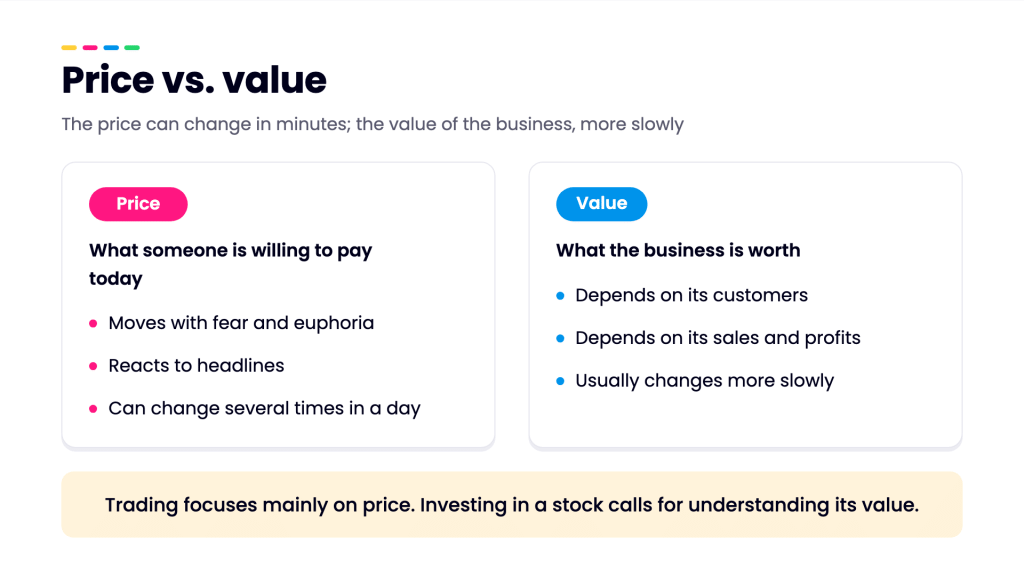
- Whether the price makes sense relative to what the business is worth.
Knowing the brand or liking the product doesn’t replace this research. Even a company with a promising future isn’t necessarily a good buy at any price.
One example: on October 26, 2026, Anthropic, the artificial intelligence company, filed a Form S-1 registration statement with the SEC for a potential initial public offering. That doesn’t mean its shares are already available to buy. The risk factors section alone runs more than 90 pages. That length doesn’t tell you whether the company is more or less risky, but it does give you a sense of how much there is to read. Three of those risks:
- Computing capacity: without enough computing capacity, the company could fall behind in developing its models; it also relies on a small number of providers.
- Profitability: it reported net losses in 2023, 2024, and 2025.
- Customers: a large share of its revenue comes from a limited number of customers.
These are risks that could materialize, not predictions. Understanding them is a different kind of work from trading, which focuses mainly on price.
What Research Says About Frequent Trading
Brad Barber and Terrance Odean studied 66,465 U.S. households investing through a discount brokerage between 1991 and 1996. The 20% that traded most often earned a net annual return of 11.4%; a market index returned 17.9%. Trading costs accounted for most of the difference.
This study comes from a different era: six years, one brokerage, and higher trading costs than today. It doesn’t predict your results or tell you which approach is right for you. What it shows is that when you trade often, costs can add up. Past performance does not guarantee future results.
Long-Term Doesn’t Mean Diversified
You can also invest in individual stocks for the long term: buy a stock and hold it for years. But your outcome depends on a single company.
A diversified portfolio spreads your money across many companies and types of investments. One way to do that is through ETFs, or exchange-traded funds, which hold a collection of stocks or bonds and trade on an exchange.
But ETFs vary widely. Some include hundreds of companies across many sectors. Others focus on one industry, such as semiconductors, and move largely in step with that industry. Before choosing one, look at what it invests in and what it costs.
Diversification can reduce your dependence on a single company or sector, but it doesn’t guarantee gains or prevent all losses. To understand why the market moves up and down, read our guide to market volatility.
How to Start Investing With a Plan
If you’re ready to get started, a simple plan can help you make decisions with a clear head:
- Your goal: retirement, your children’s college education, a home, or building wealth outside your business.
- Your time horizon: how many years until you’ll need the money.
- Your risk tolerance: how much you could watch your investment drop without changing the plan.
- Your safety net: keep business funds, emergency savings, and investment money separate.
- Your budget: an amount you can keep contributing month after month.
- The costs: commissions, fund expenses, and management fees.
- Contributions and check-ins: contributing each month can help you build the habit, though it doesn’t guarantee gains. Review your plan when your situation changes.
If you decide to take the next step, Finhabits offers diversified ETF portfolios, automatic contributions, rebalancing, and support in English and Spanish, depending on the account type. Your portfolio is built around your goal and risk tolerance. Learn how investing with Finhabits works.
Trading or Investing: Make an Informed Choice
Trading or long-term investing: the difference isn’t in the stock itself, but in what each approach asks of you in time, research, costs, and risk. Choose the approach that fits your goals and the risk you’re comfortable taking. And if picking stocks isn’t for you, you can still invest without choosing individual companies, through a diversified portfolio.
Sources
- Anthropic, PBC. Form S-1 Registration Statement. SEC, October 26, 2026.
- Barber, B., and Odean, T. (2000). Trading Is Hazardous to Your Wealth. The Journal of Finance, 55(2).
- SEC / Investor.gov. Day Trading.
- SEC / Investor.gov. Asset Allocation.
- SEC. Investor Bulletin: Investing in an IPO.
If you’re ready to invest, you can get started here.
Investing involves risk, including the possible loss of principal. Results may vary depending on market conditions. This content is for informational purposes only and does not constitute investment, legal, or tax advice. Consider consulting a qualified financial professional before making investment decisions.
This content is prepared and reviewed by the Finhabits team to ensure clarity and accuracy. It is for educational purposes only.