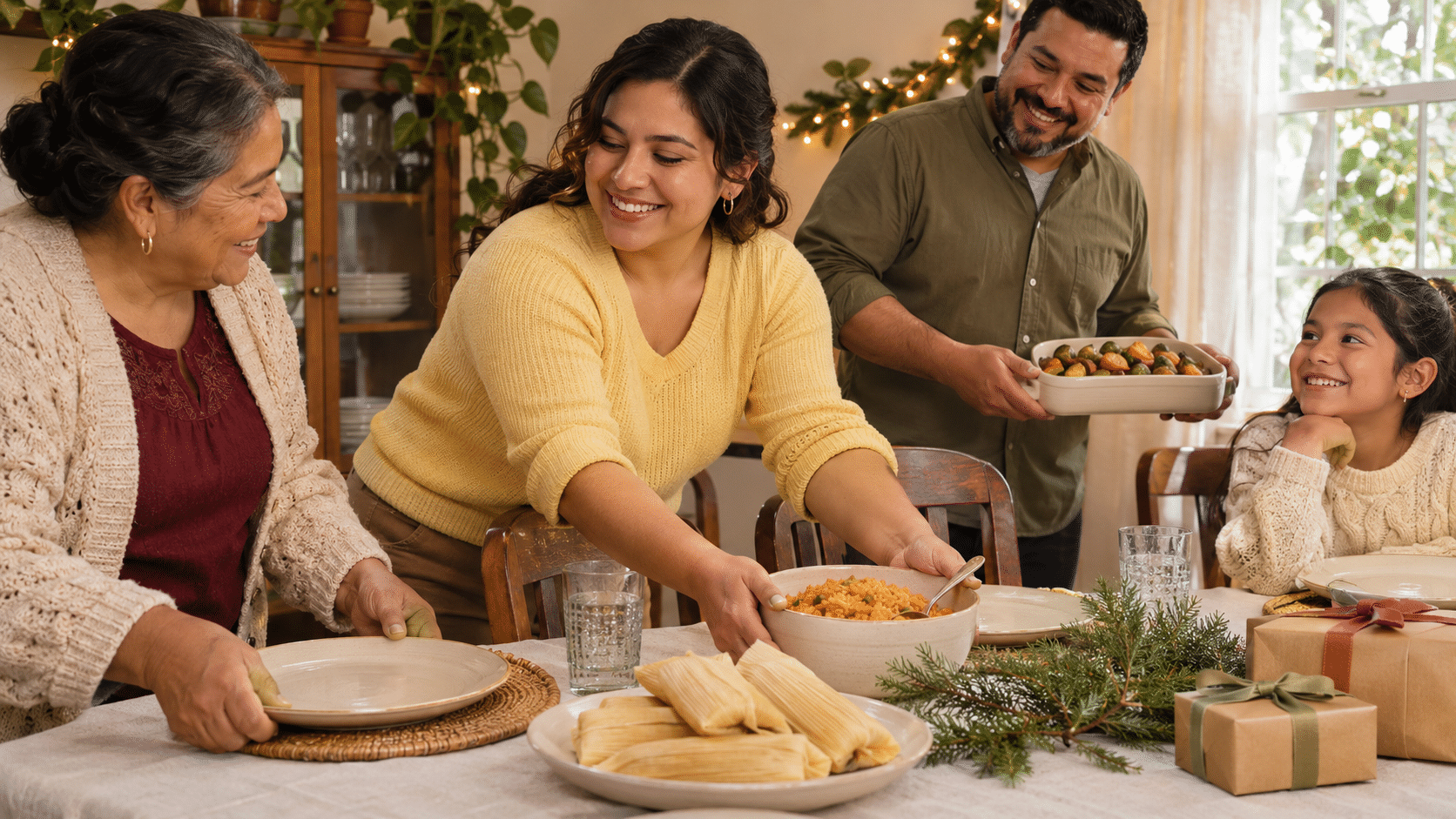
The holiday season isn’t one day. It starts with Thanksgiving dinner, runs through Black Friday, office parties and school events, peaks with the December holidays and wraps up on New Year’s. That’s about six weeks of hosting, gift-giving and, for a lot of families, traveling.
This year, the average U.S. shopper plans to spend $779 to $783 on holiday shopping alone, according to Circana and KPMG. And that number often doesn’t include the dinners, the trips or everything else the season brings.
Here’s an example. Laura and David have two kids, and this year it’s their turn to host the family for the December holidays: about 18 people. Before that, they’re going to Thanksgiving at David’s parents’ house, a flight away. They want gifts for their kids, their nieces and nephews, and a few friends. None of those expenses is excessive. The problem shows up when they all land in the same six weeks and nobody added them up ahead of time.
This guide is for doing that math early.
(Laura and David are an illustrative example, not real clients.)
1. First, look at the whole season
The most common mistake isn’t overspending on one date. It’s planning each date on its own. According to Deloitte, around 40% of a household’s holiday spending doesn’t go to gifts, but to activities like meals, outings and events.
Before you buy anything, put it all on one list:
| Date | What it usually costs |
|---|---|
| Thanksgiving (Nov 26) | Dinner, or the trip to get there |
| Black Friday and Cyber Monday (Nov 27–30) | Gifts, and sometimes something for yourself |
| December | Office and school parties, gift exchanges, decorations |
| The December holidays | The big dinner, drinks, gifts |
| New Year’s Eve (Dec 31) | Dinner or a night out |
| All season | Travel, hosting, tips and year-end giving |
What isn’t on the list is what breaks the budget.
2. Food: what it costs per person
Food prices are still rising, slowly. According to the USDA, groceries cost 1.8% more in September than a year earlier, and eating out cost 3.5% more.
The most common reference point is the traditional Thanksgiving dinner:
- The national average: the American Farm Bureau Federation (AFBF) found that dinner for 10 cost $55.18 in 2025, about $5.52 per person. Its national 2026 figure had not been published as of this guide.
- But where you live matters a lot. With the same menu, dinner cost $72.61 in California and $61.84 in Wisconsin in 2025.
- Early 2026 signals point up. In Alabama, the state’s cooperative extension estimates $75.08 for its 2026 basket, almost 10% more than in 2025. It uses a different shopping list than AFBF, so it isn’t directly comparable with the figures above, but it shows which way prices are moving.
A reference point: cook it or buy it ready
The prices chains publish give you a sense of how much the cost changes depending on how you put dinner together. This isn’t a recommendation of any store, and what you pay at yours may differ. “Per person” is the published price divided by servings.
| Chain | Type of dinner | Published price | Servings | Per person | Source |
|---|---|---|---|---|---|
| Walmart | Ingredients | $35 | 10 | $3.50 | corporate.walmart.com |
| ALDI | Ingredients | $38.74 | 10 | ~$3.87 | aldi.us |
| Target | Ingredients | $30 | 6 | $5.00 | corporate.target.com |
| Sam’s Club | Heat-and-serve | ~$160 | Up to 16 | ~$10 | corporate.walmart.com |
| Costco | Prepared | $199.99 | 8 | ~$25 | costco.com |
Published 2026 prices as of November 17. They may vary by store, region and availability, and some require a membership.
If your table seats 15 or 20
The per-person cost is what lets you do the math for your own gathering. Using the prices above, as a reference only:
- Cooking it yourself (about $3.50–$5 per person): for 18 people, $63 to $90 as a base.
- Buying heat-and-serve or prepared (about $10–$25 per person): for 18 people, $180 to $450.
These are Thanksgiving baskets. Your December holiday dinner will have its own menu and its own price, but the logic is the same. Then add drinks, dessert and whatever the basket leaves out.
One thing that helps a lot: make it a potluck. It spreads the cost and usually makes the table better.
3. Gifts: when to buy and how much
According to Adobe’s forecast, the best discounts break down like this:
- Black Friday: TVs, toys, apparel, appliances and furniture.
- Cyber Monday: electronics and computers.
Be careful shopping from your phone
More than half of online sales last Black Friday happened on a phone: 55.2%, according to Adobe. It’s convenient, but it also makes it easier to buy in seconds, without comparing. Before you pay for something expensive, look it up at another store too.
Ideas that keep the gift and lower the cost
- Fewer people on the list. Gartner found that two in three shoppers plan to buy for fewer people this year. A gift exchange with a set amount solves a lot.
- One good gift instead of many small ones. 47% prefer a single meaningful gift (Deloitte).
- Give an experience. Half of people plan to give a meal or an outing (Deloitte). An afternoon together can mean more than an object.
- Gift cards, with a set amount. They’re the most-wanted gift (47%, according to the NRF). Decide the amount before you get to the register.
4. Travel: budget for it early
Holiday travel is expensive, and more so this year. AAA projects that 81.5 million people will travel for Thanksgiving, most of them by car. If you’re flying, Hopper estimates an average domestic round-trip fare of $402, up 31% from 2025. Travelers expect to spend $740 on their Thanksgiving trip and $811 on their December holiday trip (KPMG).
If you’re traveling for both, budget for both trips now. It’s easy to think about gifts and leave travel “separate,” but it comes out of the same account. If several of you are flying, do the math per person, just like with dinner.
More than a third of shoppers say they’re canceling or postponing holiday travel because of the cost (Circana). If it doesn’t work this year, that’s a valid choice too.
5. One simple rule: don’t pay interest on a purchase
A Black Friday deal stops being a deal if you end up paying for it with interest. A $200 gift at 20% off costs $160. But if you pay it off over several months with interest, that interest eats up part or all of what you saved.
This time of year, there are two common ways to end up paying interest without noticing:
- Credit cards, when you don’t pay the full balance when the statement arrives. Using the card isn’t the problem; carrying a balance is.
- Buy now, pay later, which 21% of shoppers plan to use this holiday season, according to KPMG. Some plans don’t charge interest if you pay every installment on time; others do, and a late payment can bring fees. Read the terms before you accept.
The rule is simple: if you can’t pay for a purchase in full from your holiday budget, it doesn’t fit the plan.
The same compound interest that grows an investment also grows a debt. For more on keeping holiday spending off your cards, see Avoid Holiday Debt: 5 Smart Spending Moves.
6. Plan the season, starting with your savings
Planning isn’t spending less. It’s deciding ahead of time where each dollar goes. Plenty of people already do it: according to the NRF, 43% of people planned to start browsing or buying gifts before November, and half of them did it to spread the cost over time.
A good holiday plan includes a line people almost always forget: your savings. If it isn’t in the plan, it’s the first thing to get paused when money runs short. That’s the idea behind “pay yourself first”: your contribution is the first line of the plan, not whatever is left at the end.
Here’s how Laura and David built theirs:
- Their contribution, the first line of the plan. They have $100 scheduled every payday to invest. It transfers automatically on payday, before any purchase, December included.
- One budget for the whole season. They added up everything from Thanksgiving to New Year’s: dinners, gifts and travel. It came to $1,500. They set that money aside, separate from their emergency fund.
- A plan with room to adjust. When the plane tickets cost more than they expected, they moved money from gifts to travel. The plan changed; the contribution didn’t.
(Illustrative amounts.)
Planning early also changes how you experience the deals. If you already know how much you have for gifts, Black Friday is a chance to stretch that money, not a temptation to spend more.
Pausing your contribution “just for December” seems small, but it’s a month your money doesn’t get to grow, and restarting the habit in January is usually harder than never dropping it. Keeping your holiday money separate from your emergency fund matters for the same reason: an unexpected expense in January shouldn’t have to compete with the gifts.
A question to ask yourself before Black Friday
According to KPMG, 57% of people plan to buy something for themselves during the holidays, spending $354 on average. Repeated every year for 30 years, that adds up to $10,620 out of your pocket. That’s pure arithmetic: $354 × 30.
What would it grow into if you invested it instead? That depends on the return you assume and the time you give it. The answer is yours, and it takes a minute to find:
This isn’t about never treating yourself. It’s about knowing what that choice is worth before you make it.
Your holiday checklist
- Make sure your contribution goes out on payday, before the first purchase.
- Make one list from Thanksgiving to New Year’s, with every date.
- Set one number for the season, including travel.
- Figure out food per person and multiply by your real table.
- Make at least one gathering a potluck.
- Make your Black Friday and Cyber Monday list before the day, with amounts.
- If you’re flying, book now.
- If you can’t pay for a purchase in full and without interest, it doesn’t fit the plan.
- Keep your holiday money separate from your emergency fund.
The holidays are for enjoying. With a plan, you get to enjoy January too.
Sources
Food prices and Thanksgiving dinner
- USDA Economic Research Service — Food Price Outlook (September 2026 data)
- American Farm Bureau Federation — 2025 Thanksgiving Dinner Survey
- California Farm Bureau Federation — “California’s Thanksgiving dinner costs higher than national average” (2025)
- Wisconsin Farm Bureau Federation — 2025 Thanksgiving price survey
- Alabama Cooperative Extension System — 2026 Thanksgiving basket estimate
Published chain prices (2026)
- Walmart — Holiday Meal Basket
- Sam’s Club — Member’s Mark Thanksgiving meal
- Target — $30 Thanksgiving meal for six
- ALDI — Thanksgiving meal for 10
- Costco — gourmet turkey dinner for eight
Consumer surveys (2026 holidays)
- Circana — 2026 Holiday Purchase Intentions Study (3,534 consumers)
- KPMG — Consumer Pulse Holiday Report 2026 (2,005 consumers)
- Deloitte — 2026 Holiday Retail Survey (4,000 consumers)
- Gartner — 2026 holiday survey (1,004 consumers)
- NRF — 2026 holiday shopping survey (8,094 adults)
Black Friday and e-commerce
- Adobe — 2026 holiday online shopping forecast
- Adobe — 2025 season results, including Black Friday and Cyber Monday
- Exploding Topics — Black Friday stats (secondary reference)
Travel
2026 figures are published prices, surveys or forecasts, not final season results. Data as of November 17, 2026.
This content is educational and is not investment, legal or tax advice. Investing involves risk, including possible loss of principal. Past performance does not guarantee future results.